
EAU Position Statement: Best Practice in Using Social Media
This article was first published in Volume 87, Issue 2 of European Urology in February 2025.
Social media (SoMe) refers to computer technology that facilitates the exchange of ideas, thoughts, and information through virtual networks and communities. Medical communication via SoMe has experienced exponential growth in the past decade, and even the urology community has seen expanding engagement with representation from clinicians, researchers, and advocates.
This Platinum Opinion presents the European Association of Urology (EAU) position statement on best practices for SoMe use in urology. It summarizes current knowledge about SoMe platforms, outlines the general principles for navigating these platforms, and provides guidance for urologists and health care professionals on how to use SoMe responsibly in a professional context. Building on the previous SoMe guidelines [1], this document offers updated recommendations for modern platforms, strategies to combat misinformation, and insights into the use of SoMe analytics, along with proposed future directions for SoMe advances.
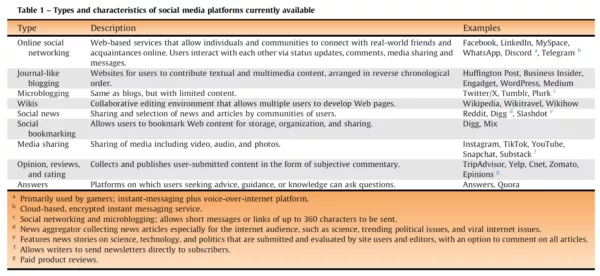
There are nine types of SoMe platform, each serving different purposes and functionalities (Table 1) [2]. An understanding of the appropriate platform according to the aim of SoMe use ensures effective communication and audience engagement in all professional contexts.
General principles for SoMe use
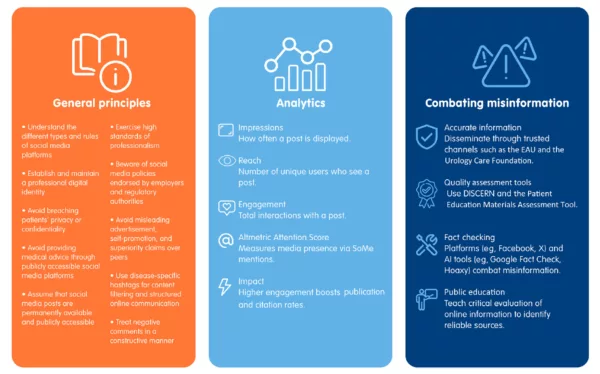
There are ten general principles that urologists should follow when using SoMe platforms (Fig. 1) [1]. Physicians should clearly state their role and align their online behavior with professional standards. It is essential to protect patient privacy by avoiding identifiable information and discussing treatment details only with explicit consent. To prevent misinterpretation, medical advice should not be given publicly on SoMe. Instead, patients should be directed to formal consultations or reliable sources. Any quotes, photos, and commentary can be taken out of context and reposted elsewhere, despite privacy settings. SoMe platforms may have the term "free use", implying that the use of existing materials from their platforms may not require further permissions, so caution must be exercised when posting content. Physicians should maintain a respectful tone and avoid personal or defamatory comments on SoMe. They should use disclaimers to clarify that their posts reflect personal opinions, and be transparent about any financial conflicts of interest.
Compliance with local regulations is essential. Physicians are encouraged to use proposed hashtags when posting content on SoMe platforms to facilitate sorting and filtering of content according to the needs of end users. Users should try to appreciate any negative comments and be open-minded in asking how they can help to rectify the situation and address any concerns. Deletion of negative comments is generally not recommended unless these comments become offensive and abusive. Similarly, blocking of users is generally not recommended unless users have repeatedly posted offensive and abusive comments.
Goals and benefits of SoMe
Optimization of the use of SoMe in urology requires a clear understanding of the goals and benefits [3,4]. Potential applications of SoMe are diverse, ranging from raising public awareness and providing education about urological diseases and their prevention, to organizing virtual and hybrid conferences to reach a broader audience, facilitating international networking, enhancing and disseminating collaborative research, and sharing resources for professional training and career advancement. In addition, SoMe platforms can be used to measure analytics, and to address and combat professional inequities within the field of urology.
Measuring SoMe impact
SoMe analytics involves the collection and analysis of data from SoMe platforms to gauge the effectiveness of information dissemination (Fig. 1) [5]. "Impressions" measure how often a post is displayed, "reach" counts how many unique users see a post, and "engagement" tracks total interactions with a post. The Altmetric Attention Score is a newer metric that evaluates the media presence of an article by aggregating mentions across various SoMe platforms and news outlets. These metrics can be measured using SoMe analytics tools that provide data on post visibility, user interactions, and broader media impact. These data reveal how content resonates with audiences, and can identify key influencers via metrics such as centrality. These analytics also show that higher engagement often correlates with higher publication likelihood and impact, as well as higher citation counts and journal impact factors, which demonstrates their value in boosting research visibility and influence.
Combating misinformation on SoMe
Studies have shown a high prevalence of misinformation in urology content on SoMe platforms such as YouTube and TikTok. A study revealed that 98% of 55 TikTok videos with the hashtag #prostatecancer, despite having 134 944 individual views, were of moderate to poor quality, with 47% containing misinformation and 10.9% showing commercial bias [6]. It is thus crucial to produce and disseminate accurate information via appropriate channels, such as the EAU Patient Information portal and the Urology Care Foundation. To promote reliable patient information and combat misinformation, tools such as the DISCERN scoring system and the Patient Education Materials Assessment Tool are essential for evaluating the quality of online content [7]. Platforms such as Facebook and Twitter/X have integrated fact-checking labels and misinformation warnings to help users in identifying false content. Artificial intelligence (AI)-powered tools, such as Google Fact Check Tools and Hoaxy, use algorithms to track the spread of misinformation and verify facts [8]. In addition, engagement in active factchecking and collaboration with reputable organizations can further reduce the spread of false information. Finally, educating the public on how to critically evaluate online information empowers them to identify reliable sources (Fig. 1).
Future directions
Novel methods of SoMe dissemination should be used, including audiovisual content on TikTok, Instagram, and Snapchat, and remote educational options on Twitch and Caffeine [9]. SoMe interventions are a novel application of SoMe that can enhance health behaviors and patient engagement via platforms such as Facebook and TikTok. Efforts should be made to standardize these interventions to enhance their credibility and effectiveness, while still ensuring a personalized multidisciplinary approach [10]. AI is reshaping SoMe health care by enabling content creation, monitoring of trends, automation, and combating misinformation. Platforms such as Meta, with its advanced tools for audience targeting, analytics, and virtual reality through Horizon Workrooms and Oculus, offer new opportunities for immersive education and virtual consultations. However, the intersection between AI and SoMe also raises challenges, including algorithm bias, privacy concerns, and the need for ethical regulation [8].
In conclusion, SoMe has transformed interpersonal interaction by providing platforms for communication, connection, and self-expression, and has gained a prominent role in the day-to-day life of health professionals across countries and cultures. However, with its pervasive influence, the benefits and opportunities of SoMe are accompanied by a host of challenges, ranging from misinformation and overuse to concerns about education, privacy, and ethics. By expanding on earlier guidelines and covering modern platforms, the EAU position statement offers urologists and other health care professionals best-practice recommendations for effective use of SoMe in the ever-evolving landscape of scientific and social communication. By applying this guidance and incorporating interactive, user-friendly content, individuals can use SoMe to significantly transform urological practice, education, and patient engagement, thereby paving the way for future advances in the field.
Authors
Jeremy Yuen-Chun Teoh, Nikita R. Bhatt, Vito Cucchiara, Esther Garcia Rojo, Vineet Gauhar, Claudia Mercader, Benjamin Pradere, Wesley Verla, Julie Darraugh, Carla Bezuidenhout, Marc van Gurp, Elisabeth Hesston, Jarka Bloemberg, James N’Dow, Maria J. Ribal, Gianluca Giannarini on behalf of the European Association of Urology Guidelines Office Dissemination Committee
For a full list of author affiliations, see the European Urology abstract.
Conflicts of interest: The authors have nothing to disclose.
References
- Borgmann H, Cooperberg M, Murphy D, et al. Online professionalism—2018 update of European Association of Urology (@Uroweb) recommendations on the appropriate use of social media. Eur Urol 2018;74:644–50.
- Koukaras P, Tjortjis C, Rousidis D. Social media types: introducing a data driven taxonomy. Computing 2020;102:295–340.
- Bhatt NR, Czarniecki SW, Borgmann H, et al. A systematic review of the use of social media for dissemination of clinical practice guidelines. Eur Urol Focus 2021;7:1195–204.
- Nolte AC, Nguyen KA, Perecman A, et al. Association between Twitter reception at a national urology conference and future publication status. Eur Urol Focus 2021;7:214–20.
- Teoh JY, Mackenzie G, Tortolero L, Rivas JG. Social media analytics: what you need to know as a urologist. Eur Urol Focus 2020;6:434–6.
- Xu AJ, Taylor J, Gao T, Mihalcea R, Perez-Rosas V, Loeb S. TikTok and prostate cancer: misinformation and quality of information using validated questionnaires. BJU Int 2021;128:435–7.
- Taylor J, Loeb S. Guideline of guidelines: social media in urology. BJU Int 2020;125:379–82.
- Bhatt NR, García Rojo E, Gauhar V, et al. The intersection of artificial intelligence and social media in shaping the new digital health frontier: powers and perils. Eur Urol 2024;85:183–4.
- Bhatt NR, Teoh JYC, Cucchiara V, et al. Novel methods of social media dissemination in urology. Soc Int Urol J 2023;4:136–8.
- Bhatt NR, Teoh JY, Garcia Rojo E, et al. Social media interventions for patients and public: opportunities and challenges for the urology community. Eur Urol 2023;84:523–6.