
EAU Receives donation of historic Gil-Vernet collection of anatomical drawings
The EAU is proud to accept the donation of the unique Salvador Gil-Vernet collection of urological drawings from the Gil-Vernet family. These unique pieces were produced from the 1940s at the Barcelona urology department under the guidance of urologist and anatomist Dr. Salvador Gil Vernet. Together, the collection represent dozens of urological breakthroughs and thousands of man-hours of research and illustration.
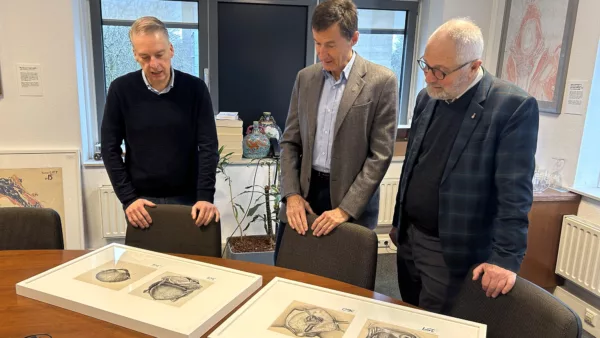
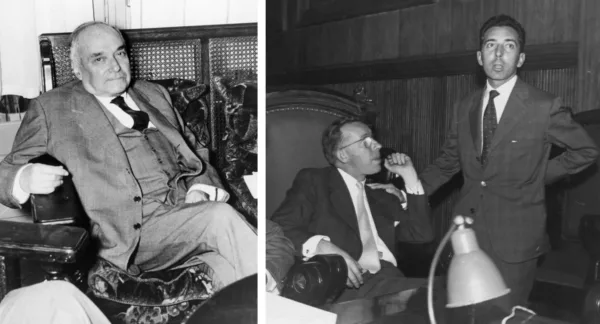
The drawings were created by the University of Barcelona’s Anatomy Department under leadership of urologists Dr. Salvador Gil Vernet (1892-1987) and his son, Prof. José-Maria Gil-Vernet Vila (1922-2020). The most recent curator of the collection was Dr. José-Maria Gil-Vernet Sedó (1957-), urologist and Salvador’s grandson.
The collection for the most part consists of anatomical drawings produced by two medical artists working for the department, as well as a series of highly-detailed drawings based on microscope sections produced by second-year medical students. In total it contains over 500 individual items. They advanced the understanding of human anatomy and surgical technique in the mid-20th century.
Unique
The significance and historic value of the collection is unique in the history of urology. Prof. Javier Angulo Cuesta, member of the EAU History Office explains:
“This collection is absolutely unique. It is really only comparable to Santiago Ramón y Cajal’s (1852-1934) ink drawings on neuroanatomy, which delivered him the Nobel Prize in 1905.”
“The collection was first used as a teaching aid in the Faculty of Medicine in Barcelona. It was also featured in numerous publications with new anatomical insights and surgical techniques by Dr. Gil Vernet. It was preserved by the family after the faculty underwent renovations in the 1980s, and catalogued by Dr. Gil Vernet’s son and grandson. I know it was Prof. Gil-Vernet Vila’s desire that the collection as a whole should go to an international society, and his first choice was the EAU with which he had many ties.”
The following description was adapted from Historia Gráfica de la Urología Española, authored by Prof. Angulo and Ignacio Otero Tejero and Mariano Pérez Albacete and published by the Spanish Association of Urology in 2025:
From 'Historia Gráfica de la Urología Española':
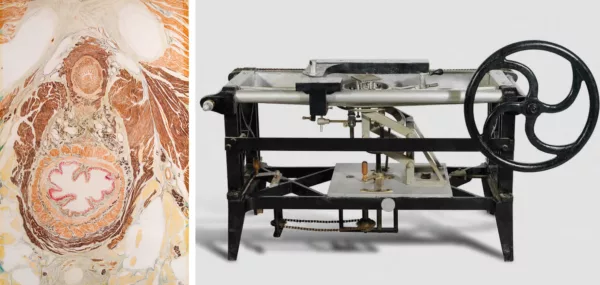
In the uro-anatomical laboratory, Gil Vernet used the histological-topographical method of the German anatomist and neurologist Otto Kalischer (1869-1942) with a giant Sartorius-Werke microtome. For each specimen, whether foetal or adult, he obtained about 200 frozen sections with a thickness of between 20 and 50 microns and dimensions of between 9 and 12 centimetres. The sections were stained with haematoxylin-eosin, and sometimes using van Gieson and Gallego trichrome or Bielschowsky's silver impregnation.
Microscopic observation of these specimens at variable magnifications, ranging from 10x to 100x, allowed the muscular and nervous elements to be separated. This had been impossible to be perceived in macroscopic dissections. The next step was to record all observations in field notebooks. Based on these pencil or pen sketches, the most interesting preparations were selected, re-examined under the microscope, and drawn in the laboratory by second-year interns on a scale of 1:7 or 1:15, first in pencil and then in colored Indian ink. This arduous work resulted in the creation of a collection of hundreds of large-format drawings between 1940 and 1970.
Prof. Philip Van Kerrebroeck, EAU History Office chair confirms the importance of this donation: "As preserving the past of (European) Urology is a main task of the EAU History Office, this collection is a major contribution to our urologic heritage, that remains a beautiful example of significant research."
Family legacy
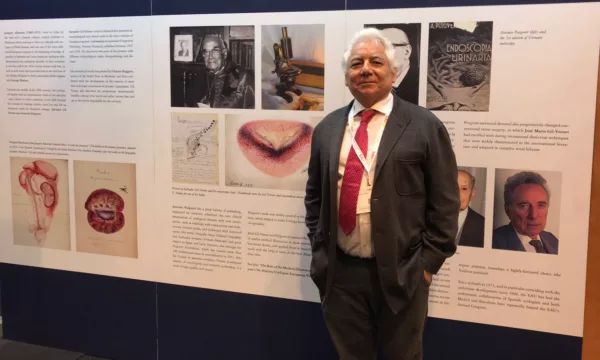
Dr. José-Maria Gil-Vernet Sedó, urologist and the third generation urologist of the family remarked on the occasion:
"I am proud to have spent decades collecting, classifying, and restoring the Salvador Gil Vernet Collection of Urology Drawings, preserving a unique visual record of medical knowledge and practice in urology.”
"The European Association of Urology's acceptance of the Salvador Gil Vernet Collection is an honour that reaffirms the Collection's importance and my deep sense of fulfilment.”
"The Gil-Vernet family's scientific legacy began with my grandfather, a distinguished anatomist. My father built on this by applying topographic anatomy to clinical practice and developing pioneering techniques in kidney stone treatment, bladder replacement, urethral surgery, and kidney transplantation. I continued our family tradition in urology by bringing these achievements together in the Salvador Gil Vernet Collection of Urology Drawings, the culmination of this effort."
Further reading:
- “Salvador Gil Vernet, A Pioneer in Urological Anatomy” by José-Maria Gil-Vernet Sedó in De Historia Urologiae Europaeae Volume 24. European Association of Urology (Arnhem, the Netherlands, 2017).
- Historia Gráfica de la Urología Española. Angulo Cuesta J, Otero Tejero I, Pérez Albacete M. Asociación Española de Urología, Método Gráfico, Madrid 2025.
- Salvadore Gil Vernet. Family website, museum and catalogue of the Gil-Vernet Collection.