
EMUC26 recap: Key insights, emerging evidence and multidisciplinary perspectives
Nearly 1,700 participants gathered in Brussels (BE) from 5-8 November 2026 for an inspiring programme of lectures, lively debates, multidisciplinary panel discussions, and interactive roundtable case update sessions. The congress once again highlighted that the greatest progress in genitourinary cancer care comes from bringing different expertise and perspectives together, turning scientific advances and multidisciplinary collaboration into better decisions and outcomes for every patient.
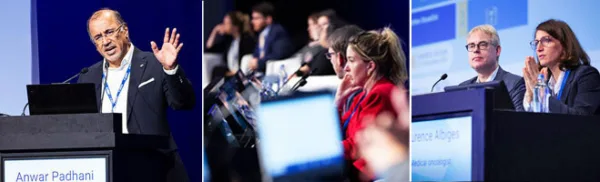
This article explores some of the weekend's key highlights from across the programme and expert perspectives discussed during several exclusive EMUCTV interviews.
Session report: Beyond survival - The road ahead for patients
“Cancer survivorship starts at the time of diagnosis and continues throughout an individual’s whole life,” stated medical oncologist Prof. Alicia Morgans (US) during the Plenary Session on 'GU cancer survivorship'. She discussed the often-overlooked psychological, cognitive and sexual health challenges. Following this, Mr. Tony Collier shared his patient perspective and the realities of life with this disease, with a powerful reminder: “Remember to treat the person, not just the cancer.”
Exclusive EMUCTV interviews
- Dr. Benjamin Pradere (FR) discusses the EV-303, EV-304, VOLGA trials with Prof. Thomas Powles (GB).
- Prof. Ros Eeles (GB) talks about individualised prostate cancer early detection strategies in the genomic era.
- Assoc. Prof. Carlotta Palumbo (IT) interviews Dr. Luca Lambertini (IT) about his winning abstract: Real world vs clinical trial outcomes in ccRCC patients eligible for adjuvant Pembrolizumab.
- Prof. Claudia Kesch (DE) interviews Assoc. Prof. Matteo Bauckneht (IT) on radioligand therapy in mHSPC
- Dr. Eduard Roussel (BE) discusses renal cell carcinoma (RCC) diagnostics in 2026 with Dr. João Lobo (PT)
- Dr. Roberto Contieri (IT) asks Prof. Jonathan Aning (GB) about “How can we make TURBT better”.
Session report: Factors to consider for individualised advanced PCa care
Plenary Session 1 “Individualised treatment in advanced prostate cancer” kickstarted with a clinical case presented by urologist Prof. Juan Gómez Rivas (ES). Led by Chairs urologists Prof. Giorgio Gandaglia (IT) and medical oncologist Dr. Pasquale Rescigno (GB), the session provided multidisciplinary perspectives on factors to consider for treatment individualisation. What would PSMA PET add to treatment selection? Which tumour and germline results could open another option? Which evidence-based options can be achieved?
Session report: AI in GU cancers - From promise to clinical reality
Artificial intelligence (AI) is rapidly finding its way into GU oncology, but how ready is it for clinical practice? Experts explored real-world applications of AI in clinical decision-making, imaging and patient follow-up, highlighting its potential to improve efficiency and personalise care. However, they also stressed the importance of clinical validation, human oversight and accountability, with AI supporting rather than replacing clinical expertise.
Access all EMUC26 scientific content
All webcasts, videos, posters and full-text abstracts EMUC26 are available via the Resource Centre.