
New tools for UTI diagnosis: Is rapid microbiological analysis feasible?
Urinary tract infections (UTIs) are among the most prevalent bacterial infections worldwide, with Escherichia coli (E. coli) being the leading causative pathogen. In patients with localised UTIs and no risk factors, treatment can generally be initiated on the basis of clinical symptoms without microbiological confirmation. However, urine culture and antimicrobial susceptibility testing are required in cases of recurrent UTIs, atypical symptoms, systemic UTIs, or the presence of risk factors.
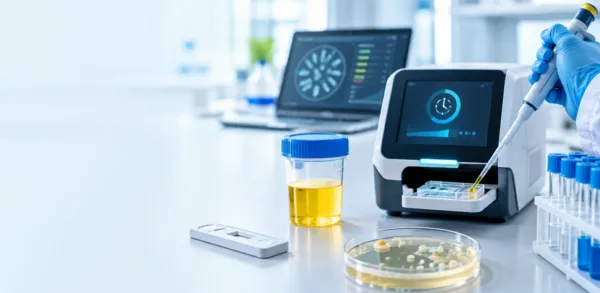
Conventional diagnostic methods, including urine culture and antimicrobial susceptibility testing, typically require 48–72 hours. This may delay targeted therapy and encourage the use of empirical antibiotics, thereby contributing to the development and spread of antimicrobial resistance. In particular, the excessive empirical prescription of broad-spectrum antibiotics remains a major concern.
To address delays in appropriate antibiotic prescribing, several alternatives for the rapid microbiological diagnosis of UTIs have been developed. These methods may be based on genotypic or phenotypic techniques, including enzyme-linked immunosorbent assays (ELISA), polymerase chain reaction (PCR), fluorescence in situ hybridisation (FISH), and matrix-assisted laser desorption/ionisation time-of-flight mass spectrometry (MALDI-TOF MS). However, their clinical implementation may be limited by their relatively high costs. Point-of-care (POC) diagnostic technologies have emerged as an alternative for obtaining rapid microbiological results directly from urine samples. These technologies include paper-based tests, lateral flow assays (LFAs), stack-pad assays, and hydrogel-based systems.
Several POC tests have been evaluated in clinical research:
- Sysmex PA-100 AST System (Sysmex Astrego AB, Uppsala, Sweden): This system detects bacteriuria within 15 minutes, providing a positive or negative result. It also provides antimicrobial susceptibility results within 45 minutes for several antibiotics, including amoxicillin/clavulanic acid, fosfomycin, ciprofloxacin, and trimethoprim. The device has demonstrated a sensitivity of 84% and a specificity of approximately 95%. The accuracy of antimicrobial susceptibility testing has ranged from 85% for ciprofloxacin to 96% for trimethoprim.
- Bosch Vivalytic UTI POCT (Bosch Healthcare Solutions GmbH, Waiblingen, Germany): This PCR-based microarray system identifies nucleic acids from uropathogens. A study using urine samples from 126 patients with UTIs reported diagnostic accuracy exceeding 90%, while the accuracy for detecting antimicrobial resistance markers ranged from 81% to 88%.
- Lodestar DX (Llusern Scientific, Cardiff, UK): This system detects DNA from major uropathogens within 40 minutes. However, it does not provide antimicrobial susceptibility results. Preliminary research involving 75 urine samples was presented at the EAU26 meeting, reporting an accuracy of 86.0%.
- fASTest: This system provides antimicrobial susceptibility results in less than 30 minutes.
- Dipstick-based tests: Several commercially available tests, including Dip UTI, TestCard, and UriScreen™, use parameters such as nitrites, leucocytes, and catalase activity to support the diagnosis of UTIs.
- Culture-based systems: Tests such as Flexicult™, UriCult® Trio, DipStreak®, and DiaSlide® provide culture-based results and, in some cases, antimicrobial susceptibility information. However, they generally require 16–24 hours to produce results. Flexicult™ has demonstrated a reported sensitivity of 79%.
Conclusion
In summary, the diagnosis and management of UTIs may evolve considerably in the near future with the implementation of POC technologies that enable rapid pathogen detection and, in some cases, antimicrobial susceptibility testing. These tools could help reduce unnecessary antibiotic prescribing and improve the selection of appropriate antimicrobial treatment. Nevertheless, further clinical validation is required to establish their diagnostic performance, cost-effectiveness, and impact on antibiotic prescribing and patient outcomes.
References
- Alonso-Tarrés C, Benjumea Moreno C, Navarro F, Habison AC, Gonzàlez-Bertran E, Blanco F, Borràs J, Garrigó M, Saker J. Bacteriuria and phenotypic antimicrobial susceptibility testing in 45 min by point-of-care Sysmex PA-100 System: first clinical evaluation. Eur J Clin Microbiol Infect Dis. 2024;43(8):1533-43. DOI: 10.1007/s10096-024-04862-3
- Davenport M, Mach KE, Shortliffe LMD, Banaei N, Wang TH, Liao JC. New and developing diagnostic technologies for urinary tract infections. Nat Rev Urol. 2017;14(5):296-310. DOI: 10.1038/nrurol.2017.20
- Hartmann J, Fritzenwanker M, Imirzalioglu C, Hain T, Arneth BM, Wagenlehner F. Point-of-care Testing in Complicated Urinary Tract Infection: Evaluation of the Vivalytic One Urinary Tract Infection Analyser for Detecting Uropathogenic Bacteria and Antimicrobial Resistance in Urine Samples of Urological Patients in a Point-of-care Setting. Eur Urol Focus. 2024; 10: 734-41. https://doi.org/10.1016/j.euf.2024.09.018
- Juste-Alvarez S, Medina-Polo J. Next-generation point-of-care diagnostics for urinary tract infections: a systematic review of rapid pathogen detection methods. GMS Infect Dis. 2026;14:Doc08. DOI: 10.3205/id000108, URN: urn:nbn:de:0183-id0001082
- Martínez-Berganza Asensio L, Largo-Rojo G, Menéndez-Fernández AI, Solano-Villarrubia C, Fuentes-Romero M, Medina-Polo J. Impact of PA-100 AST System Rapid Antibiotic Susceptibility Test on Antibiotic Prescription for Community-Acquired Urinary Tract Infections in Spanish Primary Care Settings. Antibiotics (Basel). 2026 21;15(5):520. doi: 10.3390/antibiotics15050520.
- Santos M, Mariz M, Tiago I, Martins J, Alarico S, Ferreira P. A review on urinary tract infections diagnostic methods: Laboratory-based and point-of-care approaches. J Pharm Biomed Anal. 2022; 219:114889. DOI: 10.1016/j.jpba.2022.114889
- Tomlinson E, Ward M, Cooper C, James R, Stokes C, Begum S, Watson J, Hay AD, Jones HE, Thom H, Whiting P. Point-of-care tests for urinary tract infections to reduce antimicrobial resistance: a systematic review and conceptual economic model. Health Technol Assess. 2024;28(77):1-109. DOI: 10.3310/PTMV8524.