
SHINE-URO: A consensus framework for shared decision-making in urology
Shared decision-making (SDM) has become an important facet of modern patient-centered healthcare, mirroring a shift from traditional paternalistic models toward more collaborative approaches.
At its core, SDM involves healthcare professionals and patients working together to make decisions, combining clinical expertise with the patient’s individual values, preferences, and life circumstances. This is particularly important in specialties such as urology, where treatment decisions can have significant and lasting impacts on quality of life.
Although SDM is widely associated with improved patient satisfaction and reduced decisional regret, its implementation in clinical practice is still inconsistent. One of the main reasons for this is the lack of a shared understanding of what SDM looks like in practice. Patients often interpret SDM as being listened to and supported, while healthcare professionals may see it as balancing medical guidance with patient autonomy. These differing perspectives can lead to gaps between the ideal and reality of SDM.
To address these challenges, a European consensus study was conducted by the European Association of Urology Patient Office (EAU-PO) through two live sessions in Paris, March 2024 and Rome, November 2024. The Patient Office of the EAU has worked to champion shared decision making within urological care and research, and actively promotes patient engagement through initiatives such as:
- Patient Advocacy Days at the EAU’s annual congresses,
- educational resources through the dedicated Patient Information website
- collaboration with healthcare professionals, with SDM identified as a key priority area.
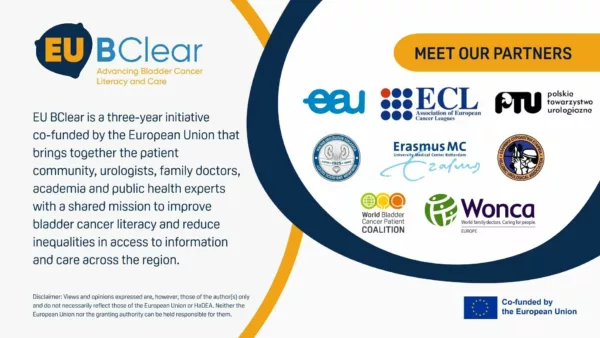
- the BCLEAR project, an EU co-funded project, aimed at creating and delivering health literacy tools for bladder cancer patients
The consensus study itself involved a series of structured workshops bringing together patient advocates, healthcare professionals, academics, and policy experts. The process began with a face-to-face meeting in Paris in March 2024, where participants discussed a draft framework based on existing SDM literature and shared their perspectives on current practices in urology. This initial meeting helped to identify key themes, challenges, and areas of agreement.
A second in-person workshop was held in Rome in November 2024, allowing participants to revisit and refine the ideas developed in Paris. During this session, stakeholders engaged in deeper discussions, clarified disagreements, and worked toward consensus on the principles of effective SDM. This iterative process ensured that the final framework reflected a broad range of perspectives and real-world experiences. Following the Rome meeting, a final version of the document was circulated among a wider group of contributors for feedback, further strengthening its validity and inclusiveness.
The outcome of this consensus process was the SHINE-URO framework, which defines six core principles for SDM in urology. These include:
- open discussion of harms and benefits,
- exploration of patient values and preferences,
- provision of clear and high-quality information,
- creation of a safe environment for sensitive discussions,
- addressing misinformation, and
- providing information prior to consultations.
Together, these principles offer a practical guide for integrating SDM into routine clinical care.
Despite this progress, several barriers to implementation were identified. Time constraints remain one of the most significant challenges, as truly resonant SDM requires in-depth discussion that is often difficult to achieve in busy clinical settings.
Additionally, inequalities in health literacy, language, and access to digital resources can limit patient participation. Through its involvement as one of the key partners in the BCLEAR project, the Patient Office raises awareness of such disparities in bladder cancer specifically by ensuring that patient voices are integral to the development of educational resources and decision-support tools. Through engaging patients alongside clinicians, the BCLEAR project helps to create practical, patient-centered approaches that empower individuals to make informed choices about their bladder cancer care.
Another important finding from the consensus study was the need to better integrate the option of not pursuing treatment into SDM discussions. Patients should be supported in considering all possible options, including non-intervention, to ensure decisions truly reflect their values and circumstances.
Concerns about the role of healthcare professionals were also addressed. While some clinicians worry that SDM tools might undermine their expertise, the consensus emphasised that these tools are intended to support, not replace, professional decisions. Clinicians are still central to guiding patients through complex decisions.
In conclusion, the consensus meetings in Paris and Rome played a crucial role in advancing a shared understanding of SDM in urology. The resulting SHINE-URO framework provides clear, practical principles for improving patient involvement in care. However, successful implementation will depend on:
- addressing systemic barriers,
- aligning stakeholder perspectives,
- and ensuring that all patients are empowered to participate meaningfully in decisions about their health.
The Patient Office is deeply passionate about embedding these objectives through its continued dedicated advocacy work with patients, healthcare professionals and involvement with projects such as BCLEAR. You can read the full article on the development and history of SHINE-URO framework here.