
The short life of Théodore Joseph Ducamp and his significant contributions to endourology
Although Théodore Joseph Ducamp (1793-1823) was described by contemporaries as a man who was “all at once an enlightened doctor, a man of genius, and a good man” [1, page 6], today he is one of the almost completely unknown physicians of the early 19th century.
In this historical study, his life and his medical research work were investigated with special consideration of his urological work and inventions in the field of endourology, which were preceded by his gynaecological work and inventions.
For that purpose, Ducamp’s original medical treatises, relevant articles and reports written by contemporary witnesses were studied. Furthermore, original treatises composed by his son Maxime were analysed. To find out the exact dates, the Fichier Laborde was used. The ‘Fichier Laborde’ is an alphabetical directory of Parisian artists and craftsmen compiled from the late 1850s onwards by Léon de Laborde (1807–1869), who served as Director-General of the Imperial Archives from 1857 to 1869. The directory was subsequently expanded in the early 20th century.
In addition, his original birth certificate was searched for and included. The Mayet collection (Collection Mayet), a compilation of Catholic records from Parisian parishes from the late 18th century to the 19th century, led to the discovery of Ducamp’s marriage certificate.
De Historia Urologiae Europaeae Vol. 33
This is the first chapter of the online 33rd volume of the EAU History Office's long-running book series. New chapters will be published throughout the year and collected as a volume in the online De Historia archive.
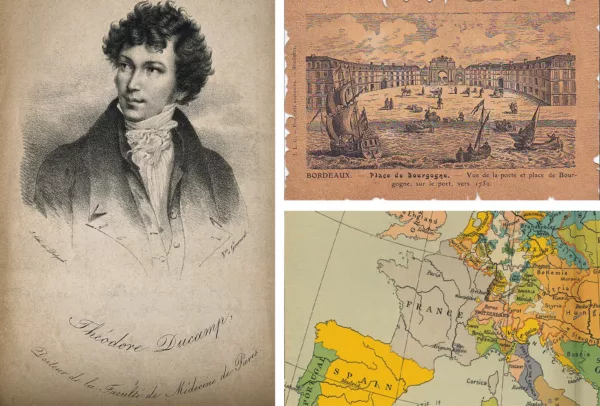
- Figure 1: Portrait of Théodore Joseph Ducamp. Licence: Public Domain Mark, Credit: Théodore Ducamp. Lithograph by Victoire Gounod (1780-1858), 1823. Wellcome Collection. Source: Wellcome Collection.
- Figure 2: Bordeaux. View of the port and Place de Bourgogne, at the port, around 1750; French postcard, public domain image
- Figure 3: France in the year 1792. Featured in the Cambridge Modern History Atlas, in 1912. Public domain.
Childhood and medical education
Ducamp (Fig. 1) was born in Bordeaux (Fig. 2), France (Fig. 3), during the French revolution (1789-1799). According to the Fichier Laborde [2] (for the original excerpt see Fig. 4) and further contemporary documents like the eulogy given for the faculty of Paris after Ducamp’s early death, which was published in the same year [1], Ducamp was allegedly born in the year 1792.
However, further research led to his original birth certificate [3] and revealed that his date of birth actually was the 3rd of January 1793 (Fig. 5). His parents were Catherine-Victoire Mugneret and Jean-Baptiste Ducamp [3, 4].
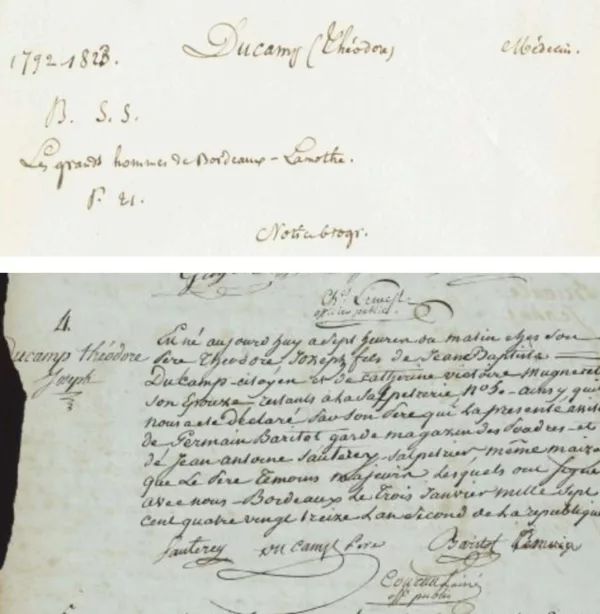
- Figure 4: Excerpt from the Fichier Laborde with the information about Théodore Ducamp.
The Fichier Laborde (“Laborde File”) is an alphabetical directory of Parisian artists and craftsmen compiled by Léon de Laborde (1807-1869), General Director of the Archives of the Empire from 1857 to 1868, from the late 1850s onwards. The file was subsequently completed by René Farge, attached to the Archives de la Seine, at the beginning of the 20th century, at the request of Alexandre de Laborde (1853-1944), the son of Léon de Laborde. The file comprises two series, the first donated to the French Bibliothèque nationale, the second to the French Bibliothèque d'art et d'archéologie. (Source) - Figure 5: Excerpt from the Registre des actes de naissance de Bordeaux, section Nord, 1er janvier 1793 - 15 nivose an II - 1er janvier 1793-4 janvier 1794, (Bordeaux Birth Register, North Section, 1 January 1793 – 15 Nivôse Year II – 1 January 1793–4 January 1794): Page 5 shows the documentation of Ducamp's birth in 1793 with the mentioning of his parents.
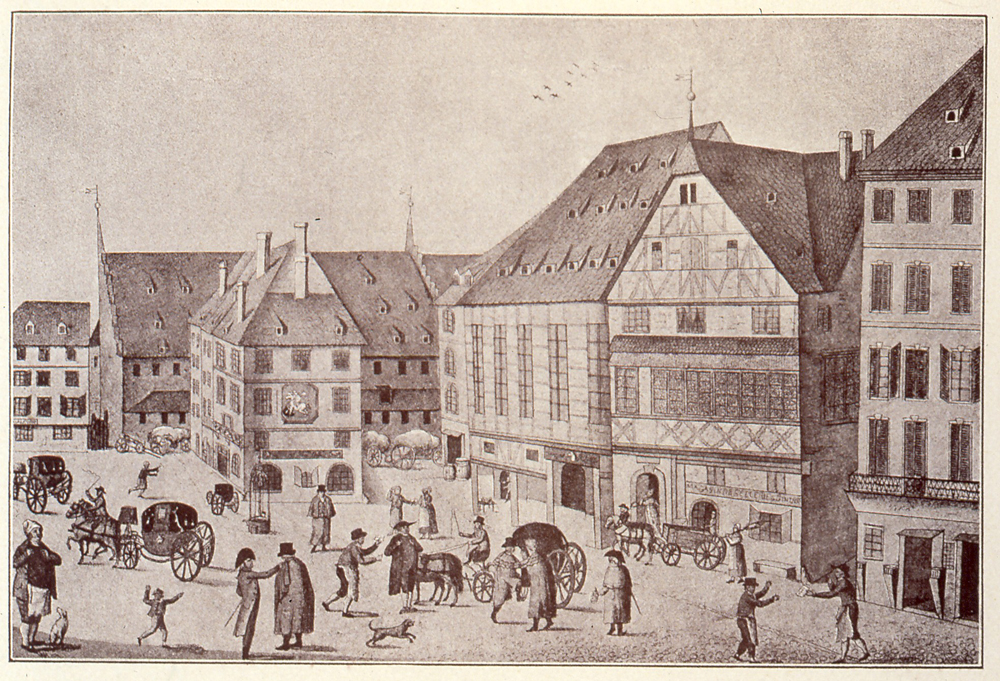
Ducamp began his medical studies in his native city at the Ecole de médecine de Bordeaux (Bordeaux medical school, Fig. 6). In 1809, he was commissioned to the military hospital of Strasbourg (Fig. 7), where he “distinguished himself by his aptitude for work, and by a tireless zeal in fulfilling the functions entrusted to him” for three years. [1, page 6]
In 1812, Ducamp was called to the military hospital of Val-de-Grâce (Fig. 8), and shortly afterwards, he was appointed assistant major in the ambulances of the Guard. [5]
At that time, the French Emperor Napoleon Bonaparte (1769–1821), also known as Napoleon I, conquered large parts of Europe. In 1813, Ducamp took part in a memorable campaign of 1813, described in more detail below. The surgical knowledge which he demonstrated in multiple serious cases was so much appreciated by his superiors that he was kept in the health service of the royal guard for the rest of 1814. [1]
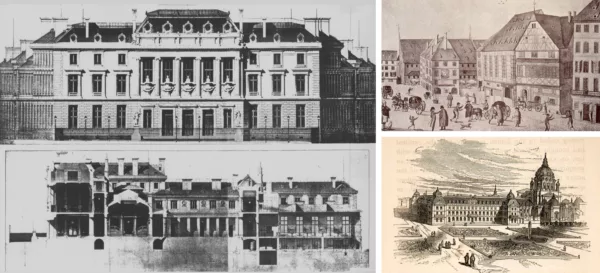
- Figure 6: Faculté de médecine et de pharmacie de Bordeaux by Jean-Louis Pascal,
L’Architecture, 1895. (Source) - Figure 7: Strasbourg around 1800.
"Paul-Louis Courier: épistolier, pamphlétaire, helléniste" (online) - Figure 8: The wood engraving of 1855 shows the Val-de-Grâce Military Hospital in Paris. The 17th-century Royal Abbey of Val-de-Grâce located near the Panthéon in the 5th arrondissement became a military hospital and medical school after the French Revolution. From 1850, it was known as the École d'application de médecine militaire.
Ducamp’s thesis about a gynaecological topic, 1815, including a case report from his stationing in lower Silesia, Germany, 1813
On the 15th of April 1815, Ducamp defended with distinction his 36-page inaugural dissertation on polyps of the uterus and vagina (“Dissertation sur les polypes de la matrice et du vagin”, Fig. 9) before the Medical Faculty of Paris. [6, (Figs 10A&B)]
In France, great advancements were made in the field of gynaecology and obstetrics in the eighteenth century. In this special area of medicine, one of the most famous physicians at that time was André Levret (1703-1780), an obstetrician of the court [7], who was very often cited in Ducamp’s thesis. The eponym “Mauriceau-Levret manoeuvre” reminds us until yet of his essential contributions in the field of obstetrics.
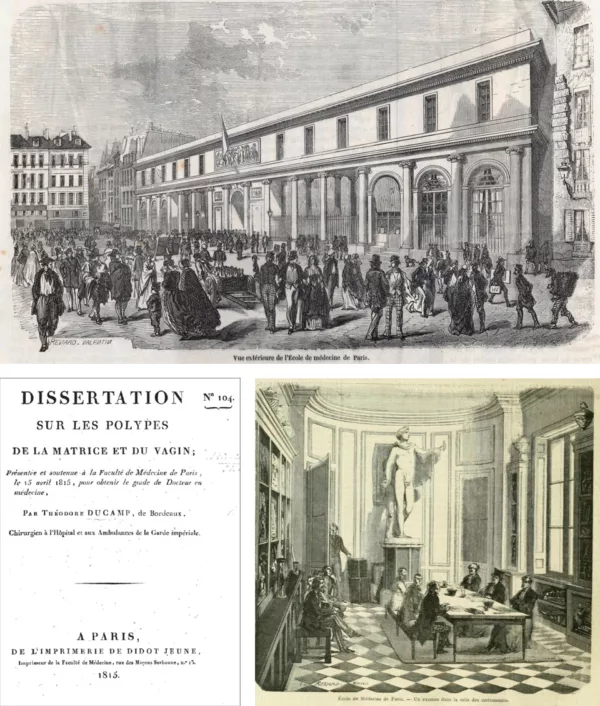
- Figure 9: Original title page of Ducamp's thesis.
- Figure 10A: Exterior view of the School of Medicine, Paris.
Illustration by Renard/Valentin, respectively, published in the Journal universel, vol. X, Nº 250, Saturday, 11 December 1847. - Figure 10B: School of Medicine, Paris, an examination in the hall of instruments.
Illustration by Renard/Bertall, published in the Journal universel, vol. X, Nº 250, Samedi 11 décembre 1847.
Levret was a revolutionary doctor who improved medical instruments for assisting delivery [8], and dispelled the belief at the time that women could only get pregnant up to the age of 45 to 50.[9] Doctors from all over Europe learnt from him. In 1757, Levret published his famous treatise Sur les polypes de la matrice et du vagin (“About polyps of the uterus and vagina”) [10], which Ducamp repeatedly refers to. Levret may have been an important role model for Ducamp, although Ducamp concentrated more on urological topics in later years.
Among others, the following eminent professors taught at the Faculté de Médecine de Paris during Ducamp’s years of study [6]: Leroux as dean, Alphonse-Louis Leroy who was named as president in Ducamp’s thesis, Desormeaux, and Dupuytren. In his thesis, Ducamp denominated himself as a surgeon at the hospital and the ambulances of the “Garde imperial”. This famous Imperial Guard was an elite military unit of Napoleon Bonaparte’s French Empire, which emanated from the Consular Guard in 1804 and went down in history for their fortitude in the Battle of Waterloo (1815) with their legendary cry “La Garde meurt, mais ne se rend pas!” (“The Guard dies but does not surrender”). [11] Ducamp dedicated his thesis “To the best of Fathers and to the tenderest of Mothers” (“au meilleur des pères, à la plus tendre des mères”) as “a well-deserved testimony of gratitude and filial devotion”.[6]
Nowadays, we associate the medical term “polyp” with harmless, smaller changes of benign dignity, at least initially. According to the Cambridge dictionary the term is defined as “a small mass of cells that grows in the body and is usually not harmful”.[12]
In Ducamp’s time, however, this term referred to a variety of very different tumours of diverse histologies and dignity, sometimes as large as a newborn’s head [6, page 7], which could lead to serious complications and even the death of the patient.
In his thesis [6, page 6], Ducamp described the following causes of the polyps as most frequent aetiologies of his time: uterine inflammation, syphilis, sexual abuse, difficult delivery, inconsiderate manoeuvres used by “certain midwives” to accelerate delivery, the use of astringent injections, and poorly conforming pessaries, which were not cleaned frequently.
Even in this early work, Ducamp’s great understanding of pathophysiological correlations and his particular attention to possible complications is evident. He pointed out the negative effects of these tumours on other organs like menstrual disorders, voiding and defaecation disorders up to urinary and faecal incontinence [6, page 8], nausea and vomiting [6, page 9], as well as possible delivery problems during childbirth [6, page 20]. Typical symptoms like a swelling above the symphysis mimicking an early pregnancy or a sensation of irritation were described [6, page 9] and pathophysiologically explained as well as more general concomitant symptoms like a syncope.
Furthermore, he discussed differential diagnoses like hernia and explained how to distinguish them from polyps by accurate examination techniques. [6, page 15-16] As severe complications he depicted haemorrhages, which could lead to weakness, meagreness and marasmus [6, page 16-17] up to the death of the patient, and an ulceration of the tumour and/or a carcinomatous degeneration characterised by a bloody or purulent discharge and an unpleasant odour [6, page 17]. The carcinomatous degeneration is classified by him as the worst complication [6, page 19], in which “the physician is reduced to using palliative means, like alleviating the terrible pain, “…mais tout espoir de guérison est perdu. La mort est la triste terminaison de cette funeste affection.” (“…but all hope of recovery is lost. Death is the sad end of this disastrous condition.”)
In his thesis, Ducamp explained and critically discussed the four different types of radical, curative treatment methods of his time [6, page 22]: cauterisation, section, removing the tumour by torsion, and ligature. Furthermore, he pointed out severe complications of these procedures ranging from haemorrhage to death. His preference for surgery is already evident in his first medical oeuvre, as well as his early deep interest in surgical instruments and their precise utilisation.
The instruments by Levret were not only theoretically described [6,page 26], but also practically used by Ducamp, when he was stationed at Polkwitz, lower Silesia, in 1813. [6, page 26] At that time, the former Duchy of Silesia had been a province of Prussia, playing a decisive role in the Franco-Prussian war. Since the end of the Second World War, it has been a part of Poland [13]. Figure 11 shows the location of the European countries in 1813.
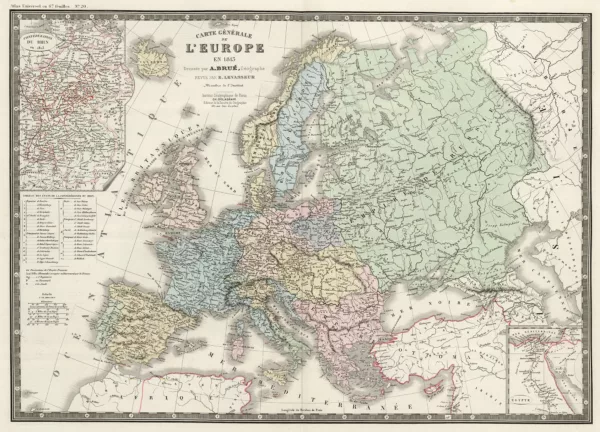
- Figure 11: General Map of Europe in 1813.
Drawn by Adrien Hubert Brue (1786-1832), Geographer. Revised by E. Levasseur, Member of the Institute, Paris Geographical Institute. Ch. Delagrave. Publishers of the Geographical Society. 58 Rue des Ecoles. Inset in the top left corner: Confederation of the Rhine. Inset in the bottom right corner: Egypt. Universal Atlas in 67 sheets No. 20. Date: 1875, Source: David Rumsey Map Collection. Public domain.
Ducamp included the following, very interesting, case report from this period in his thesis, which delivers deeper insight into the treatment methods of that time in different parts of Europe.
During the suspension of arms in 1813, the 44 year-old wife of the man Ducamp was staying with, a mother of three, asked him for advice about a gynaecological problem. She had been treated by the local barber several times using bloodlettings, as well as vomitives and purgatives. She suffered from a white, sometimes bloody discharge for two years, and often had inguinal pain, voiding and defaecation disorders, as well as a very painful sexual intercourse. Ducamp, together with another person (which is not named in his original thesis), examined the patient and found an intravaginal pear-shaped tumour of the size of a very big egg originating from the uterus. They diagnosed a polyp and recommended the operation. The woman agreed to an operation and even asked them to perform it.
Ducamp described that they could only find one instrument of Levret “in the country”, the “double tuyau de Levret”, which was utilised for the ligature of the polyp. Afterwards, injections of a decoction of elder flowers, to which brandy was added, were performed. Ducamp described the operation procedure step by step as well as the daily postoperative changes of the tumour, which could be successfully extracted on the 6th postoperative day. His ability to provide very precise descriptions over time is also evident later in his great urological work.
One month after the operation, when Ducamp left lower Silesia, the patient was in perfect health.[6]
After having achieved the doctor title, according to temporary witnesses Ducamp “devoted the day to the medical clinic, and he devoted himself during the night to the work at the doctor’s office with such ardour that dawn very often surprised him, still immersed in the deepest meditations.” [1, page 7-8]
Admission in the Société Médico Pratique de Paris, 1818, and Ducamp’s special interest in surgical instruments
In 1818, Ducamp was admitted as a resident member of the Medical Practical Society (Société Médico-Pratique de Paris), which had been founded in 1805. Contemporary witnesses recall his observations on an aneurysm of the popliteal artery, followed by some reflections on the treatment of this disease. Ducamp demonstrated that the usually used treatment methods like compression were often insufficient, while the continual application of refrigerants by means of a particular apparatus, which he presented at that time, were very often crowned with complete success. [1, page 8]
His early focus on developing new instruments to expand and improve the surgical armamentarium is again evident here.
Familiar with the area of obstetrics, Ducamp also developed an instrument usable for umbilical cord prolapse [5] Ducamp presented it to the medical-practical society in 1820 and published a notice on this instrument entitled “Nouveau moyen de remédier à l’issue prématurée du cordon ombilical” (New means of remedying the premature exit of the umbilical cord). [1, page 13]
This invention even earned him the recognition of the famous doctor Louis-Charles Deneux (1767-1846) [1, page 13], a specialist in obstetrics, who had applied to the Ministry of the Interior for the creation of a childbirth clinic in Paris since 1819. In 1823, the school was reorganised, the appropriate chair was created and Deneux was appointed. [14]
Working as a translator and commentator of a British treatise, 1819
While other French doctors tended to orientate themselves towards Italian medicine, Ducamp was known to be very interested in the English medical discoveries. His knowledge of the English language was excellent. [1, page 9] Being often faced with the treatment of respiratory diseases, Ducamp soon realised how little was known about these diseases in France and how inadequate the used methods were. [5, page 6] Therefore, he searched for treatises described by medical authors of other countries to deepen the knowledge in this field. [5, page 6]
In 1797, a very important treatise on asthma by the British physician Robert Bree (1759–1839) was published. It was entitled "A Practical Inquiry into Disordered Respiration, distinguishing the Species of Convulsive Asthma, their Causes, and Indications of the Cure". [15] Ducamp decided to translate the fifth edition of this book from the English language into French, and, as usual at that time, added notes and comments. [16] This undertaking required from him in addition to an exact knowledge of the English language that he was deeply versed in physiology, physics and chemistry, because Robert Bree’s theory was based on the application of these three sciences. [1, page 10]
Ducamp’s French translation with notes and comments was published in 1819 (Fig. 12) in association with the bookseller and publisher Nicolas Crochard (1772-1839) [17], who had been specialised in scientific and medical publishing from 1807 [17]. This publisher was located in Paris, at the Rue du Cloître-Saint-Benoît number 6 [16] and the Rue de Sorbonne number 3. Whereas the Rue du Cloître-Saint-Benoît in the 11th arrondissement [18, page 64-65] of the Sorbonne district was demolished, the home address of Ducamp at that time, the Rue Saint Martin number 79 [16], located in the 4th arrondissement of the “Quartier Saint Merri” (near today’s “Centre Pompidou”) still exists. (Fig. 13)
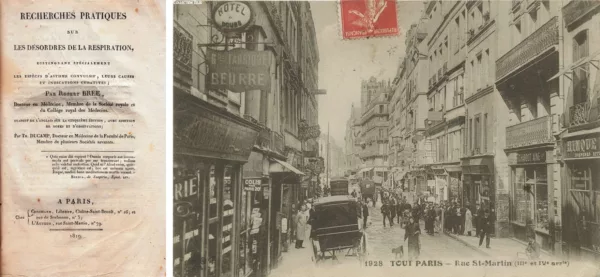
- Figure 12: Title page of Ducamp’s translation of the fifth edition of Robert Bree’s important treatise
With notes and comments by Ducamp published in 1819. - Figure 13: Postcard from 1928
Shows the Rue Saint Martin in Paris, the home address of Ducamp in 1819, located in the fourth arrondissement of the “Quartier Saint Merri” near today’s “Centre Pompidou”. This street still exists.
Further critical discussions of important treatises of his time in 1820
Following this publication (and the above-mentioned invention of an instrument to replace the umbilical cord) Ducamp was admitted to the number of resident members of the Société de Médecine de Paris (Society of Medicine of Paris) and soon became one of the contributors to the journal of this society, the Journal Générale de Médecine. [1, page 11; 19, page 56]
In 1820, Ducamp published his “Réflexions critiques sur un écrit de M. Chomel” [20], his critical reflections on the work of Chomel, who had written about the existence of fevers in his work “De l’existence de fièvres.” [21] Vassel, who was allowed to give a eulogy about Ducamp shortly after his passing in 1823 for the Société medico-pratique described this work by Ducamp as follows:
“Armed with the scalpel of a severe censorship, he dissected all the sentences of this author, one after the other....” [1, page 11-12] Ducamp “examined before judging” [5, page 7] and his judgement was independent of a person’s social status or fame. If he deemed it necessary, he was courageous enough to criticise even famous personalities, as truth was the greatest good for him! [5, page 9]
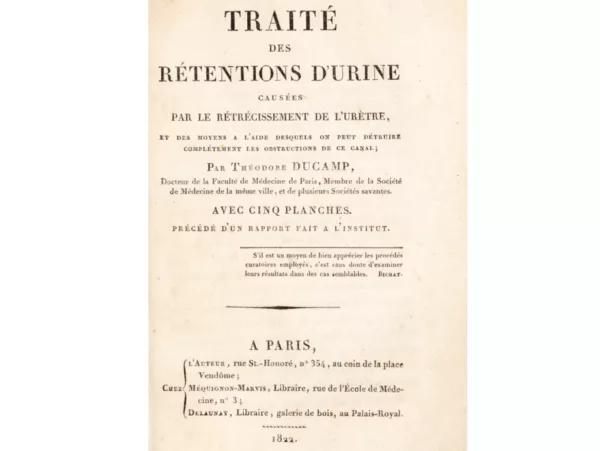
- Figure 14: Title page of Ducamp's most famous work
First published in 1822: “A treatise on retention of urine caused by strictures of the urethra, and of the means by which obstructions of this canal can be completely destroyed”
Ducamp’s most famous work in the field of endourology, from 1822, and his practical inventions/modifications of urological instruments
In 1822 Ducamp published his famous “A treatise on retention of urine caused by strictures of the urethra, and of the means by which obstructions of this canal can be completely destroyed” (“Traité des rétentions d’urine causées par le rétrécissement de l’urèthre, et des moyens à l’aide desquels on peut détruire complètement les obstructions de ce canal”). [19]
According to contemporary witnesses [5, page 10] “the zeal of friendship led him to undertake this work.” (“Le zèle de l’amitié l’engagea dans ce travail.“) It was to relieve a suffering friend that he conducted his initial research and experiments. (“Ce fut pour soulager un ami souffrant qu’il fit ses premières recherches et ses premiers essais. “) In less than a year, one hundred and fifty patients who had entrusted themselves to his care were radically cured. [5, page 11]
The original treatise consisted of around 300 pages and was divided into five chapters. (Fig. 14)
Figures 15A, 16A, 17A, 18A and 19A show original illustrations from this work. In Figure 15B, 16B, 17B, 18B and 19B the detailed explanations are given by showing the appropriate excerpts from the American version of 1827 translated and commented by William M. Herbert. [22]
Ducamp started in chapter I with a description of the anatomy of the urethra. Furthermore, he precisely described the aetiology, pathogenesis, locations, symptoms, consequences and complications of urethral strictures like overflow incontinence, gangrene, bladder or urethral rupture, megaureters, concomitant renal insufficiency, residual urine, stone formation and urinary fistula. He precisely described further effects on the urinary bladder, the upper urinary tract, the rectum and the genital organs. Similar to the serious consequences of vaginal and uterine polyps described by him in his thesis, the consequences and complications of urethral strictures at that time were much more serious than nowadays, for example he described a swollen scrotum with the size of a child’s head following a urethral rupture occurring proximal of the stricture, as well as swollen tissues of the perineum, the groins, the thighs, the upper abdomen and further genital organs due to urine “infiltration”. According to Ducamp the most frequent cause for strictures at that time was a preceding urethral inflammation due to gonorrhoea.
In Figure 15A various forms of strictures and methods how to explore them are shown.
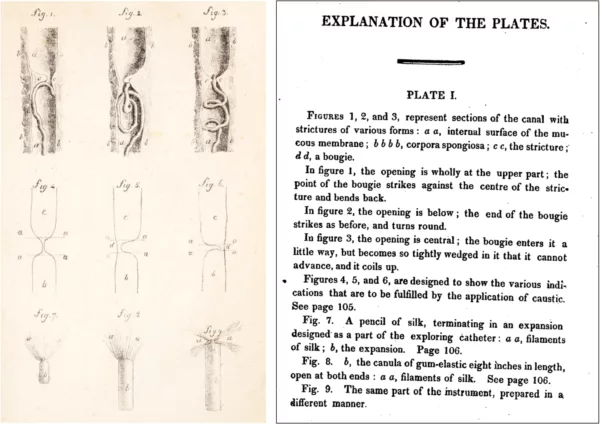
- Figure 15A: Excerpt from Ducamp's original 1822 book showing Plate I.
- Figure 15B: Explanation of Plate I using an excerpt from the translated American version from 1827
Ducamp even used experiments upon himself as evidence. He waited until his urinary bladder was filled indicated by an urgent desire to empty the bladder, then manually closed his distal urethra almost completely so that only a small stream of urine was possible and observed his body’s reactions.
He felt pain in the region of the urethra, shortly afterwards in the inguinal region and the urinary bladder. When repeating the experiment, a complete emptying of his bladder was not possible anymore, residual urine was the consequence. [19, Page 45-46] Without having modern diagnostic tools like urodynamic measurements, Ducamp’s conclusions and pathophysiological explanations based on these experiments and his comprehensive medical knowledge are amazing!
In the second and third chapter, different treatment methods of Ducamp’s time were critically discussed, pointing out advantages and disadvantages. In chapter II the treatment by dilatation and compression is discussed. Dilatations could be performed by bougies or catheters. In addition, easily comprehensible and very precise practical instructions how to perform the procedures (for example the introduction and fixation of a bougie) in a step-by-step manner were given considering possible complications and risks.
Additionally, different materials and forms were discussed, for example bougies consisting of lead or gum elastic. Ducamp did not recommend the use of bougies overall. However, if he had to choose one type of bougie, he would have opted for bougies out of gum elastic, which were hollow inside so that a lead mandrel could be inserted for better stability. [19, page 59]
In the second subchapter of chapter II Ducamp discussed the use of catheters. Interestingly, he was fascinated by the catheters invented by Sir Everard Home (1756-1832).[19, page 74] According to Ducamp, this famous English physician [23, 24] had invented, after 15 years of research, an elastic catheter with a fixed curvature, which operated without a mandrel. Ducamp succeeded in finding an excellent craftsman in Paris specialised in producing instruments out of gum elastic, Monsieur Lasserre, who started to produce such catheters and whose workshop was located at cloître Notre-Dame number 4. [19, page 74]
Ducamp always addressed the complications and risks of each method, for example perforations of the urethra or false passages when performing catheterisations. Many of his clues, especially concerning special complications and risks, are still valid!
The described procedures were applied over a longer period. For example when using bougies it took often several months to dilate the constricted urethra. When using catheters, days to weeks were needed, starting with a silver catheter for 36 to 48 hours, followed by a caoutchouc catheter for 6 to 8 days, followed by further catheters of increasing sizes. [19, page 94] Comparing both methods, Ducamp concluded that the dilatation achieved by using catheters is neither longer lasting nor more extensive than that achieved by using bougies, but more painful and risky. [19, page 102]
Ducamp described the different treatment methods for urethral strictures, which could not be dilated by bougies as performed in France and England as follows [19, page 78]:
« En France, on lui passe de vive force une sonde dans la vessie; en Angleterre, où l’on est dans une juste crainte des suites du cathétérisme forcé, on détruit le rétrécissement au moyen du caustique. »
(“In France, a probe is forcefully inserted into the bladder. In England, where there is a justified fear of the consequences of forced catheterisation, the stricture is destroyed using caustic substances.”)
His later described new methods should combine, modify and refine different approaches.
Finally, in the third subchapter of chapter II, Ducamp specified the three different methods for a puncture of the urinary bladder at his time: abdominal punction (hypogastric region), perineal punction and punction via the rectum. The indication was defined as complete urinary retention lasting 15 to 20 hours and unsuccessful trials to pass a catheter or bougie into the bladder. If that procedure was not performed Ducamp named as consequence a rupture of the urethra or the bladder and in the worst case the death of the patient. Ducamp explained exactly the different procedures including the positioning of the patient. He preferred the abdominal puncture.
In chapter III, treatment methods by mechanical destruction using pressure or by chemical destruction of the stricture, for example utilising armed bougies and an escharotic, were analysed raising advantages as well as disadvantages. Ducamp studied the English treatises on the subject intensively and quoted, for example, from Sir Everard Home’s (1756-1832) extensive work. [19,page 121] He precisely described Hunter’s armed bougie in which a piece of silver nitrate was embedded in one end. [19, page 118] Silver nitrate was an often-used escharotic in England at that time and Ducamp’s favoured escharotic agent, too.
Ducamp’s outstanding trait not to shy away from criticising even famous colleagues when he recognised that certain procedures posed a high risk to patients became also noticeable in this treatise [19, page 120]: “Introducing a caustic into the urethra and pushing it forward without knowing what is being spared or what is being destroyed is a crude manoeuvre unworthy of the high aim of surgery and hardly suited to honour the person who performs it.”
(“Introduire un caustique dans l’urètre, et le pousser en avant sans savoir ni ce qu’on épargne ni ce qu’on détruit, est une manœuvre grossière indigne du haut but de la chirurgie, et peu propre à honorer celui qui l’exerce.“)
Ducamp pointed out that patients commonly had to be treated between four and 20 times using that method, but that sometimes even up to several hundred procedures were necessary: “There are patients on whom one hundred, two hundred, five hundred, and in one case even 1,258 procedures were performed.” (“Il est des malades sur lesquelles on en a fait cent, deux cent, cinq cents, et sur l’un même 1258.”)
He quoted from Home’s famous treatise [25] to substantiate the latter statement [19, page 121] and concluded: “Such abuse of such a forceful means is truly horrible.” (“Un tel abuse d’un moyen aussi énergique est vraiment épouvantable.”)
Ducamp expounded the possibility to achieve good final curative outcomes using that method but explained also that a worsening of the patient’s condition could likewise be the result [19, page 143]: “…with this treatment, one plays double or nothing.” (“…avec ce traitement l’on joue à quitte ou double.”)
In the fourth chapter, Ducamp described diagnostic and treatment methods developed or modified by himself including a variety of instruments invented or modified by him. He refined a special method to determine exactly the length, extent and form of strictures using an exploring catheter and a bougie loaded with a specially compounded moulding wax. It was introduced by a special instrument called a “conducteur”. (Figs. 16A & B) By that way, he took a mould of the stricture. His conductor was also used during the treatment procedure to introduce bougies.
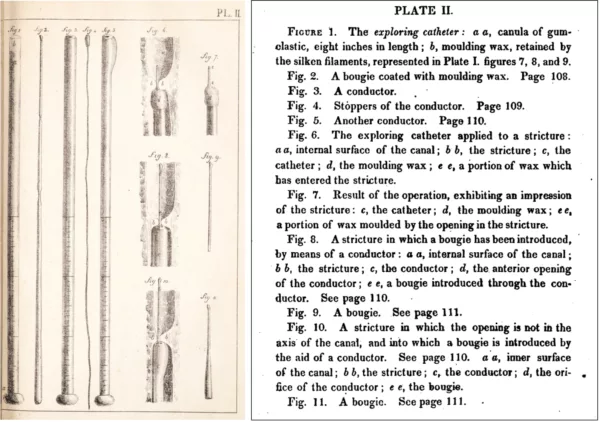
- Figure 16A: Excerpt from Ducamp's original 1822 book, showing Plate II
- Figure 16B: Explanation of plate II using an excerpt from the translated American version of 1827
Furthermore, he developed the “porte-caustic”, an instrument for applying the caustic exactly at the stricture to avoid chemical burns of healthy tissue.
The figures 6 and 7 of the original Plate III (Figs. 17A&B) show the “porte-caustic” shut and open, and in figure 8 and 12 of this plate it is applied to a stricture.
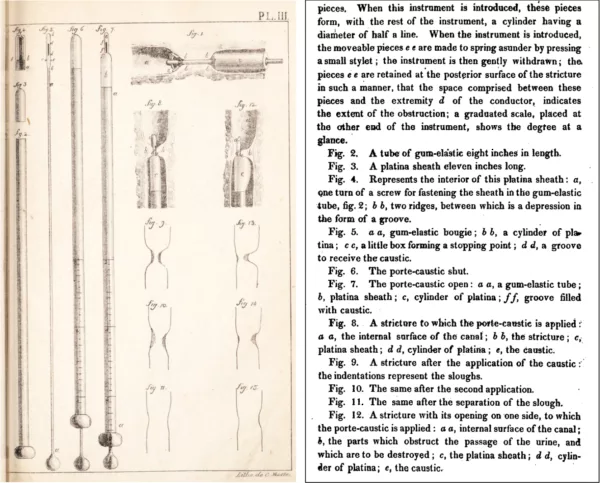
- Figure 17A: Excerpt from Ducamp's original 1822 book: Plate III
- Figure 17B: Explanation of plate III using an excerpt from the translated American version of 1827
Ducamp also improved and adapted preexisting dilators. Instead of conical plaster bougies he recommended bellied (bougie à ventre) or cylindrical ones. (Figs. 18A & B)
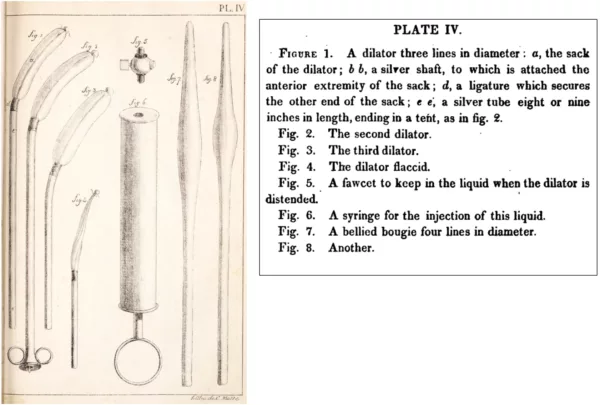
- Figure 18A: Excerpt from Ducamp's original 1822 book: Plate IV
- Figure 18B: Explanation of plate IV using an excerpt from the translated American version of 1827
Ducamp initially filled the dilator with air only, but encountered the problem that air escaped at certain points in his assembled device, which made it difficult to achieve a prolonged dilation. He solved this problem, as he described in his own words as follows [19, page 177]:
“I managed to overcome this problem by reassembling the instrument as follows: I push air into the dilator until I feel a slight resistance, and then I close the valve; I fill the syringe with water, replace this instrument on the valve, open the valve, and I force water over the air: the air, strongly compressed by the column of water weighing upon it, condenses; the volume of air, which previously occupied the entire dilator, now fills only half or a third of it, and the water fills the remainder. In this way, I produce a much greater distension, and if the dilator loses pressure, the compressed air expands and maintains the distension...”
Employing all these newly developed or modified instruments, Ducamp introduced a new method of treatment for urethral strictures performed in multiple steps over several days utilising an escharotic agent, especially nitrate of silver, different dilators inflated with (compressed) air and bellied bougies of increasing sizes.
Ducamp considered preoperative planning and diagnostics between successive operations as well as the treatment of inflammation before performing special procedures to be very important for a successful, curative and long-lasting operative outcome.
Finally, in the fifth and final chapter of his work, remarkable case reports were described including complicated cases with combined prostate enlargement, bladder infections or retention of urine aggravated by previous treatments unproperly conducted. The original Plate V (Figs. 19A&B) showed 40 figures of impressions taken from most of these patients.
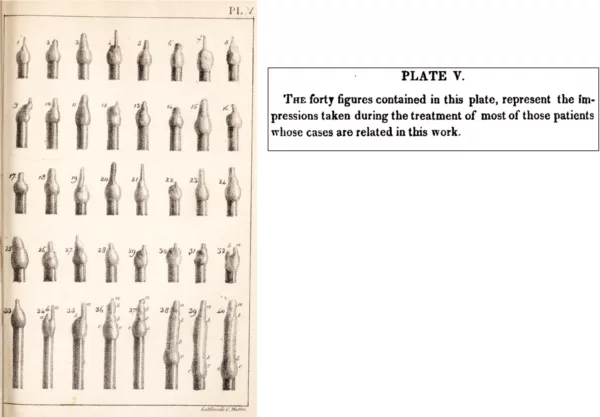
- Figure 19A: Excerpt from Ducamp's original 1822 book: Plate V
- Figure 19B: Explanation of plate V using an excerpt from the translated American version of 1827
Ducamp was also one of the first physicians who proposed a new method for the treatment of bladder stones by destroying the stones inside the urinary bladder instead of performing the dangerous and painful “opération de la taille”.[5, page 11] He even developed an instrument to destroy stones inside the bladder but was unable to gain experience with it and perfect it, since he became very ill. [5, page 11-12] This illness forced him to stop treating patients from February 1823 onwards. [5, page 12]. There was reportedly a crowd of patients gathered outside the locked doors of his practice, as patients wanted him to continue treating them. [5, page 12]
His illness is described as progressive and consuming, and Ducamp was said to be aware that he was going to die.[1, 5] In the last days of his life, he wrote his will, which also contained instructions on how his magnificent urological work should be continued after his death [5, page 13-14]: (“Mon ouvrage est bientôt épuisé. Je n’entends point, sous quelque prétexte que ce soit, qu’on fasse aucun changement dans le texte : je veux que mes pensées restent ce qu’elles sont. On suivra pour la réimpression le volume où j’ai fait quelques corrections. Il faudra qu’on substitue la description de mon nouveau porte-caustique; on le fera représenter dans tous ses détails, et on supprimera l’ancien.») –
“My book will soon be out of stock. Under no circumstances do I wish for any changes to be made to the text: I want my thoughts to remain as they are. The reprint will follow the volume in which I have made a few corrections. It will be necessary to substitute the description of my new porte-caustic; one will have it represented in all its details, and one will remove the old one.”
Furthermore, he also determined that the following paragraph should appear at the beginning of the reprint: (“Il (moi) considère comme parfaitement apte à le remplacer dans la pratique et dans l’emploi journalier de ses instruments, Monsieur Nicod, chirurgien en chef de l’hôpital Beaujon, demeurant rue Saint-Florentin n° 8.») - “He (I) considers Monsieur Nicod, chief surgeon of the Beaujon hospital, residing at number 8 rue Saint-Florentin, to be perfectly capable of replacing him at the medical practice and in the daily use of his instruments.”
In this way he cared for his patients beyond death.
The Early Death of Ducamp in 1823 and his legacy
Ducamp died in Paris on the 1st of April in 1823 at the age of thirty.[1, 5] His last work was considered so important at that time that it was translated into different languages.
An English translation by William M. Herbert with notes and additions by this translator was published in the USA in 1827 by Samuel Wood and Sons (Fig. 20) [22], located on 261 Pearl St., New York, between 1817 and 1836.[26] This version, as well as the Frech version, are still in print.
Additionally, his treatise was translated into German and published in 1823 by Leopold Voß, a publisher from Leipzig, Germany. (Fig. 21) [27, 28] The second edition of his French book was published in 1823, the third edition in 1825.[5]
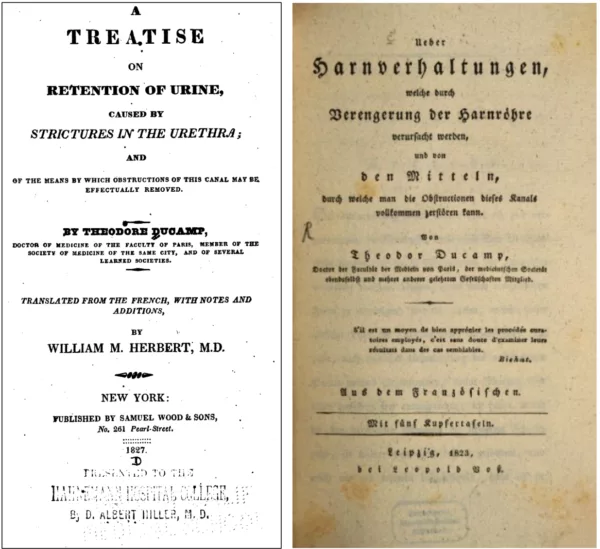
- Figure 20: Title page of the American version of Ducamp's treatise published in 1827 by Samuel Wood and Sons, New York.
- Figure 21: Title page of the German version of Ducamp's treatise published in 1823 by Leopold Voß, a German publisher from Leipzig, Germany
Ducamp’s family life
Ducamp was married to Alexandrine Chéronnet (1802-1837). Figure 22 shows a bust of her as part of an exhibition at the Louvre Museum, which was donated by their son Maxime in the year of her death. Figure 23 shows the original documentation of Ducamp’s marriage to Alexandrine Chéronnet on the 9th of May 1821 as an excerpt of the Collection Mayet, in which also the names of his parents and Ducamp’s address at that time (Rue St. Martin) were documented.
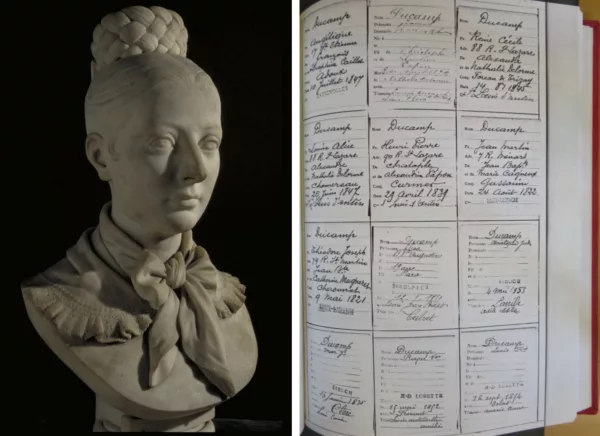
Figure 22: Bust of Alexandrine Ducamp, Louvre
Collection: Département des Sculptures du Moyen Age, de la Renaissance et des temps modernes; Artist: Dantan, Antoine-Laurent dit aussi (also called), Dantan Aîné (1798 - 1878); description: Alexandrine Chéronnet. Veuve du chirurgien (Widow of the surgeon) Théodore-Joseph Du Camp. Mère du critique d'art (Mother of the art critic) Maxime Du Camp (1822-1894). Fabrication in 1837; donation by her son Maxime.Permalink © 1994 Musée du Louvre, Dist. GrandPalaisRmn / Pierre Philibert
- Figure 23: Original document about Ducamp’s marriage to Alexandrine Cheronnet
Excerpt from the collection Mayet with the original documentation of his marriage to Alexandrine Chéronnet on the 9th of May 1821, in which also the names of his parents were documented as well as the church in which the ceremony took place, the roman-catholic church Saint Madeleine, and his address “Rue Saint Martin” number 79 in Paris.
The famous French photographer and writer Maxime Du Camp (1822–1894, Fig. 24) was their son. Maxime was a close friend of the novelist Gustave Flaubert with whom he travelled. His Égypte, Nubie, Palestine et Syrie (“Egypt, Nubia, Palestine and Syria”)[29], written after one of their journeys and published in 1852, is among the first books illustrated with photographs.
The address of Ducamp’s young widow is indicated as Rue Saint-Honoré number 354, at the corner of the place Vendôme, in Paris (Fig. 25) [30]. She is mentioned as one of the publishers of the second and third edition [30] of his famous urological treatise republished after his early death.
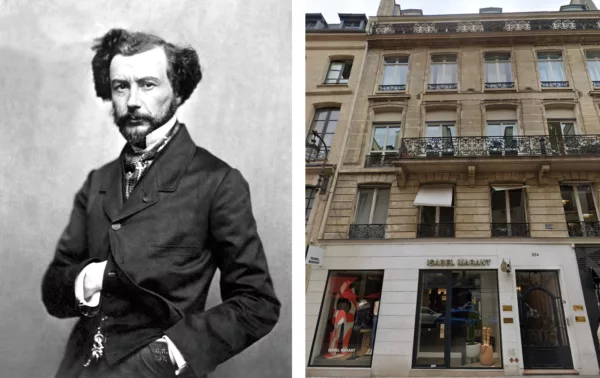
- Figure 24: Son of Théodore Ducamp
Maxime Ducamp (1822–1894), French writer and photographer. Photography taken in the 1860s by Nadar (1820–1910), public domain; Maxime Ducamp was a close friend of the novelist Gustave Flaubert with whom he travelled. His Égypte, Nubie, Palestine et Syrie (1852), written after one of their journeys, is among the first books illustrated with photographs.
- Figure 25: The address of his wife Alexandrine who republished his famous urological work after his death is named as Rue Saint-Honoré number 354, at the corner of the place Vendôme, in Paris. This picture was achieved using Google Maps and shows exactly the house in which she lived at that time.
Conclusions
Théodore Joseph Ducamp contributed to a much better understanding of the aetiology, pathophysiology and treatment of diseases of the lower urinary tract, especially in the field of urinary retention, urethral strictures and bladder stones. Although his life was very short, his major urological work was even at his time internationally respected and outlasted the times. It established the basis for modern endourology and is still in demand.
The most outstanding characteristic of this excellent physician was his courage to speak the truth when it was necessary for the advancement of medicine and served the sick, even when he was verbally attacked for doing so.
The following take-home messages based on his research are just as important nowadays as in his times:
- It is the intention behind which counts: The motivation behind Ducamp’s written works and practical inventions was to help and heal patients and improve diagnostic and therapeutic methods.
- If inadequacies of common treatment methods with high risks for the patients are identified, they must be examined, discussed, named and eliminated or improved.
- Preoperative planning, diagnostics between successive operations and the treatment of inflammation before performing operations are very important for a successful outcome.
- Do not count the number of the operations, count the number of the complications and analyse them!
Dedication
Interestingly, Ducamp’s life journey also took him to Lower Silesia (Niederschlesien). I therefore dedicate this article to three extraordinary, very strong women who were born in Lower Silesia and, as children, were resettled to another part of Germany after the end of the Second World War: my mother, Helga Badawi, and my favourite aunts and godmothers, Aunt Gretel (Margaret) and Aunt Inge. Children do not cause wars, but they pay the highest price. All three were also role models for me in a professional sense, having demonstrated strength, perseverance, reliability, empathy, care for others, and generosity. I miss your loving care, your wonderful support (including in my professional life, especially from my mother), our meaningful conversations and your wise advice day after day.
Acknowledgements
Many thanks to Monsieur Jean-Cyril Lopez, Chef de service, Service des publics, Direction de la Gouvernance documentaire et des Archives, Archives Bordeaux Métropole, Parvis des Archives, 33100 Bordeaux, France, for the essential information regarding Ducamp’s original birth certificate, and to Mr. Frédéric Laux, Directeur, Direction de la Gouvernance documentaire et des Archives, Archives Bordeaux Métropole, Parvis des Archives, 33100 Bordeaux, France, for important general information on this matter.
References
- Vassal, Pierre Gérard. Eloge historique de Théodore Ducamp, lu à la Société médico-pratique dans la séance du 14 mai 1823. Paris, Impr. de Dondey-Dupré (1823).
- “Le répertoire du marquis Léon de Laborde (1807-1869), dit « Fichier Laborde »”. Institut National d’Histoire de l’Art. Online: https://www.inha.fr/actualites/le-repertoire-du-marquis-leon-de-laborde-1807-1869-dit-fichier-laborde/ (last accessed 16 September 2026).
- “Registre des actes de naissance de Bordeaux” (Bordeaux Birth Registrer), section Nord, 1er janvier 1793 - 15 nivose an II - 1er janvier 1793-4 janvier 1794, page 5.
- Fichier des mariages parisiens (collection Mayet), AD75 Mayet T082 - Paris, France - Compiled vital records from Paris, France, Collection Mayet, 1795 - 1862, File number : AD75 Mayet T082, page 147. Online: https://en.geneanet.org/archival-registers/view/30072/147 (last accessed 16 September 2026).
- Notice sur l’auteur (Note on the Author). In: Third edition of Théodore Ducamp’s Traité des rétentions d’urine causées par le rétrécissement de l’urètre, et des moyens à l’aide desquels on peut détruire complètement les obstructions de ce canal. Published in 1825 by Ducamp’s wife and the publishers Baillière, Rue de l’école de Médecine number 14, and by Delaunay, galerie de bois, au Palais-Royal, Paris, France.
- Ducamp, Théodore. Dissertation sur les polypes de la matrice et du vagin. (1815)
- Stockmann, Nicole. “L’obstétrique et la gynécologie dans la vie française au XVIIIe siècle.” In: École pratique des hautes études. 4e section, Sciences historiques et philologiques. Annuaire 1973-1974. (1974). pp. 867-871; doi : https://doi.org/10.3406/ephe.1974.5965
- Karamanou M, et al.: “André Levret (1703-1780): The eminent obstetrician of the 18th century and his innovative approach to the treatment of uterine polyps.” Journal of the Balkan Union of Oncology (2017) 22(2): 562-565 ISSN: 1107-0625, online ISSN: 2241-6293.
- “André Levret (1703-1780)”. Die Schweizer Hebamme. Official organ of the Swiss Midwives Association. Vol. 33, no 2. Published on the 15th of February 1935, Switzerland, by Bühler & Werder, Bern, Switzerland.
- Levret A. “Sur les polypes de la matrice et du vagin.” Mém. De l’Acad Royale de Chir 1757; 3: 518.
- Brun, Jean-François. “La Garde Impériale (1/4)”. Napoleon.org, Le site d’histoire de la Fondation Napoléon. Online: https://www.napoleon.org/histoire-des-2-empires/articles/la-garde-imperiale/ (last accessed 16 September 2026).
- “Polyp.” Cambridge Dictionary. Online: https://dictionary.cambridge.org/dictionary/english/polyp (last accessed 16 September 2026).
- “Schlesien”. Deutsches Kulturforum Östliches Europa. Online: https://kulturforum.info/de/component/content/article/6252-schlesien?Itemid=1019495 (last accessed 16 September 2026).
- “Heilly (80) Nogent-Le-Rotrou (28) - Louis-Charles Deneux, Médecin Accoucheur De S.A.R. Madame, Duchesse De Berry”. La Maraîchine Normande. Published 7 September 2016. Online: https://shenandoahdavis.canalblog.com/archives/2016/09/07/34292920.html (last accessed 16 September 2026).
- Bree, Robert. A Practical Inquiry into Disordered Respiration, distinguishing the Species of Convulsive Asthma, their Causes, and Indications of Cure. London, United Kingdom (1797).
- Ducamp, Th. Recherches pratiques sur les désordres de la respiration, distinguant spécialement les espèces d’asthme convulsif, leurs causes et indications curatives, par Robert Bree,... traduit de l’anglais sur la cinquième édition, avec addition de notes et d’observations. Published by Ducamp, Th., rue Saint-Martin, Paris, and Crochard, Cloître-Saint-Benoît, number 16, and rue de Sorbonne, number 3, Paris, 1819
- “Crochard, Nicolas.” Geographicus: Rare Antique Maps. Online: https://www.geographicus.com/P/RareMaps/crochardnicolas (Last accessed 16 September 2026).
- Lazare, Félix and Louis Lazare. Dictionnaire administratif et historique des rues de Paris et de ses monuments (1844). p64-65
- Ducamp, Th. Traité des rétentions d’urine causées par le rétrécissement de l’urètre, et des moyens à l’aide desquels on peut détruire complètement les obstructions de ce canal. Published by Ducamp, Th., rue St.-Honoré, number 354, Paris, Méquignon-Marvis, rue de l`Ecole de Médecine, number 3, Paris, and Delaunay, galerie de bois, Paris, 1822.
- Ducamp, Th. Réflexions critiques sur un écrit de M. Chomel ayant pour titre: "De l’Existence des fièvres". (1820)
- Chomel, A-F. De l’Existence des fièvres. (1820)
- Ducamp, Théodore. A treatise on retention of urine, caused by strictures in the urethra and of the means by which obstructions of this canal may be effectually removed. Translated from the French, with notes and additions, by William M. Herbert, 1827. Published by Samuel Wood and Sons, New York, USA.
- “Everard Home, 1756-1832”. The Royal Society, Science in the Making. Online: https://makingscience.royalsociety.org/people/na4668/everard-home (last accessed 16 September 2026).
- “Everard Home (1756-1832)”. The Geological Society. Online: https://www.geolsoc.org.uk/the-library/online-exhibitions/mary-anning-and-the-geological-society/bibliography-mary-anning/everard-home/ (last accessed 16 September 2026).
- Home, Everard. Practical Observations on the Treatment of Strictures in the Urethra, and in the Oesophagus. G. Nicol & J. Johnson, London (1797).
- “Samuel Wood and Sons [261 Pearl Street].” The Women’s Print History Project, 2019, Firm ID 5477. Online: https://womensprinthistoryproject.com/firm/5477(last accessed 16 September 2026).
- Ducamp, Théodore. Ueber Harnverhaltungen, welche durch Verengerung der Harnröhre verursacht werden, und von den Mitteln, durch welche man die Obstruktionen dieses Kanals vollkommen zerstören kann. German translation published in 1823 by Leopold Voß, Leipzig, Germany.
- Pfau, Karl Friedrich. “Voß, Leopold”. Allgemeine Deutsche Biographie Vol. 54 (1908), S. 777. Online: https://www.deutsche-biographie.de/pnd117450812.html#adbcontent (last accessed 16 September 2026).
- Du Camp, Maxime. Égypte, Nubie, Palestine et Syrie : dessins photographiques recueillis pendant les années 1849, 1850 et 1851 et accompagnés d’un texte explicatif et précédés d’une introduction par Maxime Du Camp chargé d’une mission archéologique en Orient par le Ministère de l’Instruction publique. Published by Gide and J. Baudry in 1852.
- Third edition of Théodore Ducamp’s Traité des rétentions d’urine causées par le rétrécissement de l’urètre, et des moyens à l’aide desquels on peut détruire complètement les obstructions de ce canal. Published in 1825 by Ducamp’s wife and the publishers Baillière, Rue de l’école de Médecine number 14, and by Delaunay, galerie de bois, au Palais-Royal, Paris, France.
Suggested for you
See allThere are no news articles related to this page right now. See all news articles