
32 Volumes of 'De Historia' book series now available online
The EAU History Office has digitised and made freely available all 32 volumes of De Historia Urologiae Europaeae. For over 30 years, the book series was an exclusive member benefit or for sale separately. The decision was made to give the articles within their pages a new, wider audience.
Hundreds of authors, including some of the biggest names in urology have contributed chapters on the history of our field, covering topics like medical breakthroughs, biographies of (proto) urologists, and depictions of urology in the ancient world.
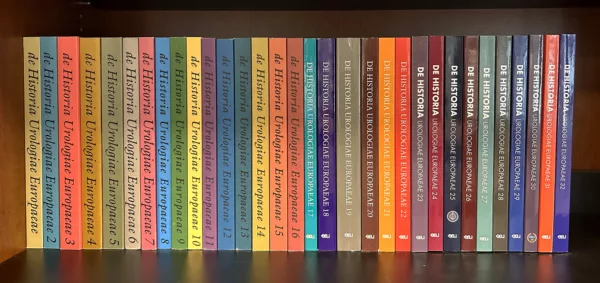
In recent years, the pages of De Historia were filled with contributions from the speakers at the EAU’s Annual Congresses, but also members and associates of the History Office. The first few volumes, published in the 1990s attempted to cover the history of urology in each European country in the spirit of our unified continent. Modern-day urologists will not only be interested in the topics discussed within these pages, but also serve as a memory of those who wrote them and are perhaps no longer with us.
The books are presented in their original typeset format, but in an online environment on Uroweb, the EAU’s website. Each volume is laid out with an illustrated overview of its contents, making browsing, searching and reading convenient and breaking down the barriers between the physically separate books. In total, over 400 contributions are now presented anew. Because the series is presented in an unedited, original form, some attitudes and terminology may no longer be considered accurate or appropriate, but the History Office is nevertheless extremely proud of this massive, multi-decade body of work.
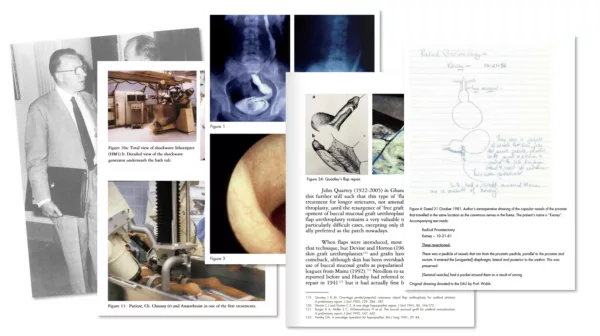
Highlighted: First-hand accounts
A selection of some of the first-hand accounts published in De Historia over the years:
- The History of The European Association of Urology
Willy Gregoir
From Vol. 1 (1994): A fascinating insight into the origins of the Association and the first ten congresses from the perspective of its founding Secretary General.
- Extracorporeal Shockwave Lithotripsy: An Eyewitness’s Historical Review
Christian G. Chaussy
From Vol. 24 (2017): In Prof. Chaussy’s own words, the development of ESWL at his department in the early 1980s.
- Ureteroscopy: A Visual History of a Crucial New Urological Procedure
Enrique Perez-Castro
From Vol. 27 (2020): Prof. Perez-Castro details the development of breakthrough ureteroscopes, changing minimally-invasive surgery forever.
- A History of the Treatment of Urethral Stricture Disease
Anthony R. Mundy
From Vol. 28 (2021): Prof. Tony Mundy gives a detailed overview of the history of the treatment of urethral stricture disease, including his own experiences and techniques.
- Nerve-sparing radical prostatectomy: A European discovery?
Patrick C. Walsh
From Vol. 31 (2024): the surgeon who co-discovered and performed the first nerve-sparing radical prostatectomy explains in his own words the serendipity that led to his collaboration with Dutch anatomist Dr. Pieter Donker and their life-saving discovery.
This new online home for this historical content will also serve as a hub for future chapters. Articles based on talks from the Annual Congress and other submissions will be published as long-form news items on Uroweb and added to annual volumes on the De Historia webpage.
The History Office will continue to publish printed books for EAU members who visit the Annual Congress, with a new publication to be presented at EAU27 in Amsterdam in March 2027.
About the series
Since 1994, the EAU History Office has produced 32 volumes of original research into the history of urology in De Historia Urolgiae Europaeae. The founding editor was Dr. Johan Mattelaer, chair of what was then the Historical Committee.
The first volumes attempted to systematically document the origins of urology in each European country, written by experts from the country in question. Over the years the contributions became more wide-ranging and stretched to urology in prehistory, biographies of pioneers, and remarkable and colourful stories from urological history.
Major redesigns took place in 2010 and again in 2016 as printing technology made full-colour covers possible. The size has always remained the same. It is customary for the current chair of the EAU History Office to be the main editor of the series. Prof. Van Kerrebroeck is the third editor in these 32 years, joined by Prof. Dirk Schultheiss and Mr. Jonathan Goddard. The volumes are produced in-house at the EAU’s headquarters in Arnhem, the Netherlands.