
ESU course on urolithiasis brings advanced stone management to Cyprus
On 28 March 2026, the Atlantica Miramare Beach Hotel in Limassol, Cyprus, hosted the 6th Urological Symposium of the Cyprus Urological Association (CUA) — a landmark event that brought together 109 healthcare professionals, including 28 speakers and 14 moderators, for a full day of scientific exchange.
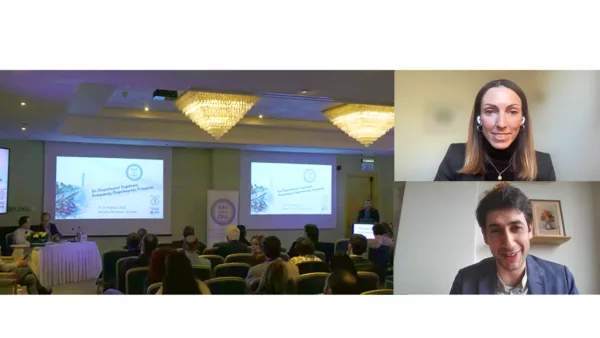
As part of the symposium programme, we were honoured to co-organise a dedicated European School of Urology (ESU) course, “Breaking Stones, Building Knowledge: A One-Day Masterclass on Urolithiasis”, delivered by two outstanding ESU faculty members Dr. Begoña Ballesta Martinez (ES),Chair of EAU-YAU Endourology and Urolithiasis and Head of the Urology Department at the Hospital Universitario del Vinalopó in Alicante, Spain and Dr. Arman Tsaturyan (AM), President of the Armenian Association of Urology and Chief of Onco-urology at Erebouni Medical Center in Yerevan, Armenia.
The session was moderated by Dr. Ballesta Martinez, Prof. Athanasios Papatsoris (GR), and Dr. Demetris Kontaxis (CY), and opened with a brief introduction by Dr. Ballesta Martinez on the unique educational opportunities offered by the ESU — a reminder of the its role in delivering world-class urological training across and beyond Europe.
Precision in stone diagnosis: From laboratory to imaging
Dr. Tsaturyan presented the first scientific lecture: “EAU Guidelines recommendations on precision in stone diagnosis: From laboratory to imaging.” He walked delegates through the full diagnostic pathway, from urinalysis and metabolic evaluation to the optimal use of low-dose CT, ultrasound, and plain radiography at each clinical decision point. He emphasised that metabolic workup following stone treatment, while sometimes perceived as complex, is both achievable and essential in routine practice — particularly in recurrent stone formers — and that integrating it into everyday workflows significantly improves long-term outcomes.
Conservative and medical management: Evidence into everyday practice
Dr. Ballesta Martinez then presented “Role of conservative and medical management: Evidence into everyday clinical practice.” She provided a compelling, evidence-based review of lifestyle modification, dietary advice, and pharmacological prevention. One key take-home message that resonated strongly with the audience was dietary calcium should not be restricted in stone formers. This is a recommendation still frequently misunderstood in clinical practice. She also covered pH modulators and crystallisation inhibitors, reinforcing that prevention in urolithiasis is not only effective but simple and cost-efficient to implement.
Surgical strategies: Selecting the optimal modality
Dr. Tsaturyan returned after the break with “Surgical strategies: Selecting and refining the optimal modality”, a detailed and practically-focused lecture anchored in the EAU Guidelines 2026. He presented the treatment algorithms for renal and ureteric calculi across the full size spectrum, guiding delegates through the evidence base for shockwave lithotripsy (SWL), retrograde intrarenal surgery (RIRS), ureteroscopy (URS), and percutaneous nephrolithotomy (PCNL). He discussed how patient anatomy, stone characteristics, and local expertise should jointly inform the choice of modality — a message that was particularly relevant for a mixed audience of urologists practising across varied clinical settings.
The future of stone management: Innovation, integration, and insight
The session concluded with Dr. Ballesta Martinez’s lecture on “The future of stone management: Innovation, integration, and insight”, exploring emerging technologies and the evolving role of artificial intelligence, novel laser platforms, and miniaturised access in shaping endourology. Her presentation set an optimistic and forward-looking tone for the discipline.
Interactive case discussion and closing reflections
The course culminated in a lively interactive case discussion with local faculty Dr. Theocharis Karaolides (CY) and Dr. Prodromos Philippou (CY) joining the two ESU speakers.
The cases highlighted the real-world complexities urologists routinely face: challenging anatomy, significant patient comorbidities, and the importance of maintaining a broad surgical repertoire. The discussion underscored the value of multidisciplinary collaboration and peer consultation in navigating difficult stone cases.
The warm reception of this course by our delegates reflects a strong appetite for high-quality, guideline-based urological education in Cyprus. The CUA looks forward to continuing its productive collaboration with the ESU in future symposia.