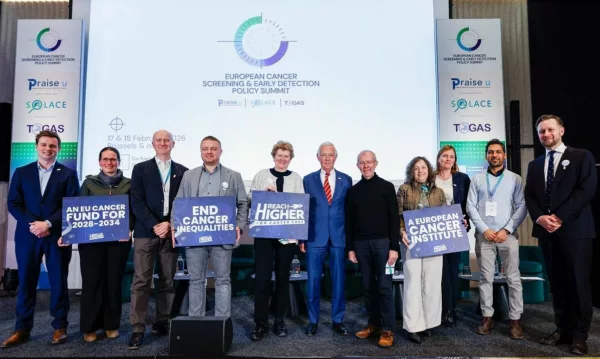
European Cancer Screening and Early Detection Policy Summit
From pilot projects to policy implementation: advancing prostate cancer screening in Europe
On 17–18 February 2026, policymakers, clinicians, researchers, patient advocates and public health leaders gathered for the European Cancer Screening and Early Detection Policy Summit, a two-day event dedicated to advancing implementation of new cancer screening approaches across the EU.
Chaired by Stella Kyriakides, former European Commissioner for Health and Food Safety, and David Collingridge, Editor-in-Chief of The Lancet Oncology, the Summit showcased three implementation-focused projects funded under the EU4Health Programme (2021–2027):
- PRAISE-U – Personalised Risk-based screening for Prostate Cancer in the EU
- SOLACE – Lung cancer screening using low-dose CT
- TOGAS – Gastric cancer prevention strategies tailored to European communities
While all three projects aim to strengthen early detection of cancer in line with Europe’s Beating Cancer Plan and the 2022 Council Recommendations on cancer screening, PRAISE-U was a central focus of the discussions on organised, risk-based prostate cancer screening.
Together, the three initiatives demonstrate a broader European commitment to organised, evidence-based screening for multiple cancers. However, PRAISE-U stands out in its detailed, structured approach to personalised risk-based prostate cancer screening and its readiness for national scale-up.
Day 1 – Achievements and progress since the Council Recommendations
Moderated by physician and journalist Sarah-Taïssir Bencharif, Day 1 of the Summit focused on implementation progress and lessons from the pilot programmes.
Setting the policy context
The opening session positioned PRAISE-U within the broader European cancer policy landscape. Speakers reflected on how the 2022 Council Recommendations have created political momentum to move from opportunistic to organised screening programmes.
For prostate cancer, this shift is critical. As Prof. Hein Van Poppel emphasised in his presentation, prostate cancer is now the most diagnosed cancer in men in Europe and among the leading causes of cancer mortality. With incidence projected to rise by 2040, the need for smarter early detection is urgent.
Early-stage prostate cancer is typically asymptomatic, so early detection on the basis of symptoms or warning signs is not possible. There is also no established prevention strategy, which makes screening and imperative in terms of improving survival rates, and lowering the economic, social and personal toll of advanced prostate cancer. However, as other speakers during the Summit emphasised, screening must strike a careful balance between reducing mortality and avoiding overdiagnosis and overtreatment, which is exactly what PRAISE U proposes to do.
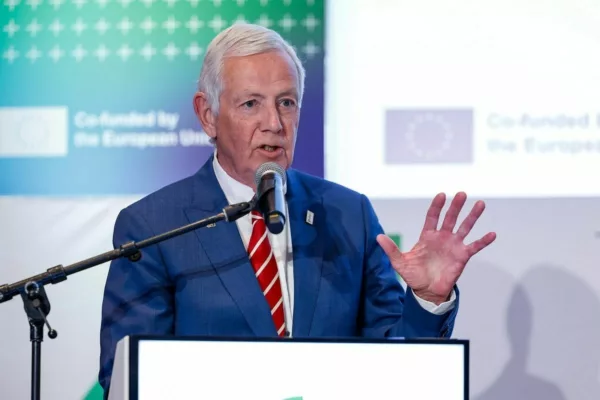
PRAISE-U: Smarter, risk-based prostate cancer screening
Throughout the Summit, PRAISE-U demonstrated how this balance can be achieved.
A structured package for implementation
Lionne Venderbos, Assistant Professor in the Department of Urology of Erasmus University Medical Center, presented the PRAISE-U implementation package developed for collaborators and pilot sites. This comprehensive toolkit includes:
- A clear implementation protocol
- A dedicated helpdesk for practical guidance
- Country based factsheets
- Defined KPIs and a full codebook to ensure consistent data collection
- Ready-to-use participant materials (informed consent forms, information sheets, video materials)
- PRAISE U knowledge hub
Importantly, PRAISE-U does not simply launch pilots, it monitors and evaluates them rigorously through:
- The PRAISE-U data registry and data monitoring team
- Quality Control
- Capacity assessments at the start of each pilot
- Scalability assessments to evaluate expansion potential
- Sustainability assessments to ensure long-term integration
This structured approach is designed to help Member States transition from pilot initiatives to organised, evidence-based national screening programmes.
Not “one-size-fits-all”: The PRAISE-U methodology
Professor Monique Roobol, Professor, Decision Making in Urology and the Head of the scientific research office within the Department of Urology at Erasmus Medical Centre Rotterdam reinforced that prostate cancer screening should not be uniform or opportunistic. Instead, it must be personalised and risk-based. She highlighted the benefits of the PRAISE-U knowledge hub, which is a central repository available for all.
The PRAISE-U strategy is built on:
- Initial PSA testing
- Risk stratification
- MRI only when elevated risk
- Further risk stratification
- Biopsy only when necessary
This stepwise approach reduces unnecessary procedures while improving detection of clinically significant cancers.
The value of PRAISE-U pilots is that they are happening in real world settings, in 5 regions across the EU, with different resource capacity, health systems and cultures. The data being gathered through PRAISE-U are crucial for better understanding how the algorithm works in real life, outside of clinical trials. Importantly, the PRAISE-U study is also mapping the psychosocial impact on men through the screening pathway, particularly focusing on stress and anxiety levels, but also on health literacy levels.
Repeat screening is also a core component. Understanding long-term outcomes requires ongoing follow-up and integration with EU research initiatives, including collaboration with EU-level screening projects. The PRAISE-U project works to ensure that screening remains evidence-based, high-quality and aligned with emerging research.
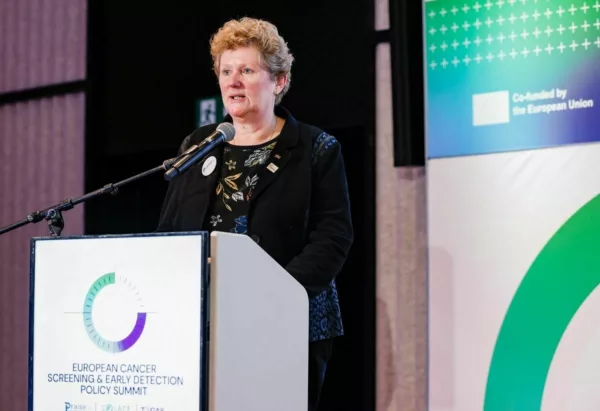
The economic case: From modelling to policy
Day 2 of the Summit opened with an in-depth exploration of cost-effectiveness.
Pieter Vynckier Post-doctoral Researcher, University of Ghent presented advanced modelling work using Discrete Event Simulation (DES) to evaluate prostate cancer screening strategies. Unlike traditional models, DES simulates individual patient pathways based on:
- Age
- PSA levels
- Risk profile
- Re-screening and follow-up pathways
Because early cancer cannot be directly observed, the model also simulates pre-clinical disease stages, offering a more realistic analysis of screening impact.
Cost-effectiveness ultimately falls into four scenarios:
- More effective & more costly
- Less effective & more costly
- Less effective & less costly
- More effective & less costly, the overall goal
PRAISE-U aims to achieve the fourth scenario: improved outcomes at sustainable cost, demonstrating that early detection is less expensive than late-stage treatment.
Erik Briers , Vice-Chair, EuropaUomo, complemented this discussion by highlighting the patient journey - from awareness and PSA testing to shared decision-making before treatment. His message was clear: screening must be step-by-step, informed and personalised.
Data, scalability and the European Health Data Space
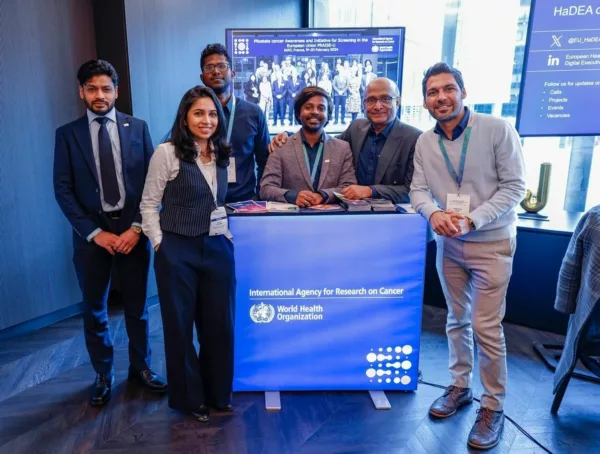
Data collection and sharing emerged as a critical theme. Arunah Chandran , Public Health Officer at the International Agency for Research on Cancer (IARC), discussed how PRAISE-U data systems will align with the European Health Data Space framework.
Importantly, data extends beyond clinical indicators. PRAISE-U incorporates:
- Clinical data and outcomes
- Capacity assessments
- Psychosocial outcomes
- Stakeholder feedback
- Cost-effectiveness metrics
- Workforce and infrastructure planning indicators
These data streams will support scaling-up decisions and inform EU-level policy planning.
Maintaining political momentum
The final high-level session, facilitated by Stella Kyriakides, examined how to sustain political commitment and financial investment in screening.
Sarah Collen, representing the EAU Policy Office and PRAISE-U, underlined the importance of:
- Keeping cancer screening high on the EU political agenda
- Ensuring equity of access across Member States
- Securing funding under the next Multiannual Financial Framework
- Delivering on Europe’s Beating Cancer Plan and the Council Recommendations
The message was consistent throughout the Summit: pilot projects must translate into organised national programmes.
Conclusion: From pilots to programmes
The European Cancer Screening and Early Detection Policy Summit made one thing clear: Europe is moving from discussion to implementation.
For prostate cancer in particular, the case for organised, risk-based screening is stronger than ever. Through robust modelling, structured pilot evaluation, stakeholder engagement and EU-level policy advocacy, PRAISE-U is building the framework necessary to transition from fragmented testing practices to equitable, evidence-based national screening programmes.
Early, smart and equitable screening is not only clinically sound, but economically responsible and politically necessary. The next step is clear: scale up, sustain momentum and ensure that organised prostate cancer screening becomes a reality across the European Union.
We thank the European Cancer Organisation for their dedication and commitment towards the implementation of new cancer screening approaches, and for graciously hosting this remarkable event.