Inside the ESU Course on endourology and renal cancer surgery: A report on highlights
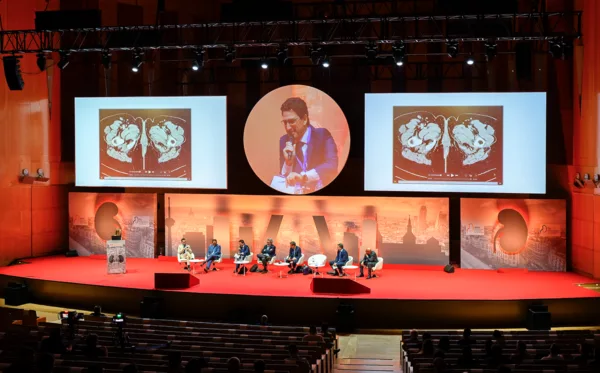
The 89th Urological National Congress of the Spanish Association of Urology (AEU) took place in Madrid, Spain from 10 to 12 June 2026. Within the successful congress, the first plenary session “Training Today the Urologists of Tomorrow: The Role of the European Association of Urology and the Spanish Association of Urology”, led by Dr. Mario Álvarez Maestro (ES), Dr. Alberto Carrión (ES), Dr. Angelo Territo (ES), and myself, comprised various activities such as the very interesting course organised by the European School of Urology (ESU).
Dedicated ESU course
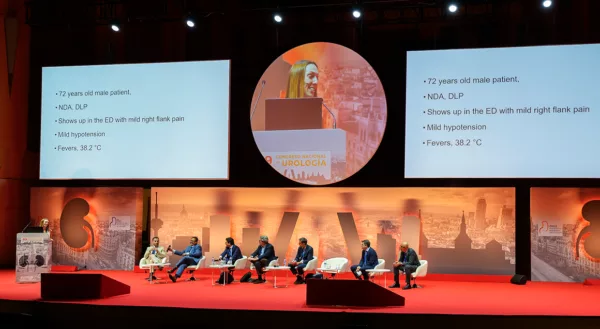
Dr. Roberto Ballestero (ES), Dr. Ramón Cansino (ES) and Prof. Bhaskar Somani (GB) moderated the ESU course, which featured practical surgical insights and updates on endourology and renal cancer.
The course started with “European School of Urology: A unique possibility for urological education”, a very inspiring lecture by Prof. Somani where he presented an overview of the ESU’s educational opportunities designed for urologists throughout every stage of their careers. These included hands-on training programmes, masterclasses on several different disciplines, courses, fellowships, scholarships, mentorship programmes, podcasts, online learning resources, and international networking opportunities, to name a few.
Prof. Somani’s presentation highlighted the European Association Urology’s (EAU) long-standing commitment to accessible, high-quality education, and its central role in training the next generation of urologists. The panel showed high interest in these programmes and asked Prof. Somani several questions.
Robotics matters
The scientific programme of the session then shifted to advanced robotic surgery with the expert from the EAU Robotic Urology Section, Prof. Andrea Minervini (IT). He delivered an excellent step-by-step guide to the robotic retroperitoneoscopic approach for partial nephrectomy.
Drawing on his extensive and valuable experience, he covered patient selection, operating room setup, anatomical landmarks, trocar positioning, and the technical nuances required to perform the procedure safely and efficiently.
Close collaboration
Overall, the ESU course successfully combined educational vision with practical surgical tips and tricks on how to perform the procedures discussed safely and effectively. It also showcased the close collaboration between the EAU and the AEU.
Nightmare cases
The lecture was followed by the interactive session “Nightmare cases for robotic partial and radical nephrectomy,” where Prof. Minervini presented a series of challenging and shocking clinical case scenarios, sharing practical strategies for anticipating and managing the displayed intraoperative difficulties and complications. The lively discussion allowed participants to compare different approaches and benefit from a wide range of surgical experience.
The focus of the ESU-EAU-AEU joint session then moved to endourology where Prof. Somani provided a comprehensive, step-by-step review of retrograde intrarenal surgery (RIRS). His presentation covered every stage of the procedure, from patient preparation and renal access to stone treatment and postoperative management, emphasising technical details that optimise efficiency while minimising complications.
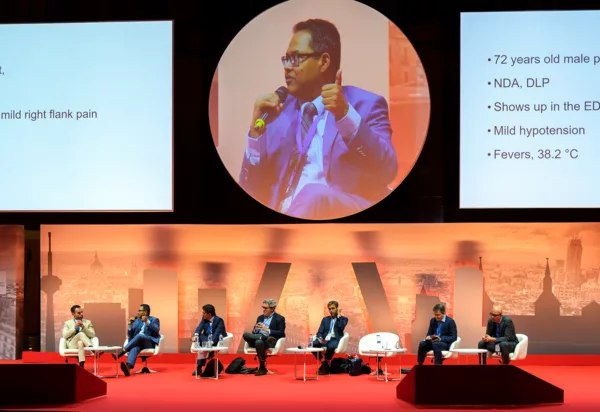
This was followed by “Nightmare cases for retrograde intrarenal surgery,” an engaging discussion of complex cases encountered during flexible ureteroscopy that I presented and discussed by the panel, led by Prof. Somani. As with the previous session, the expert panel discussion encouraged audience participation and generated valuable exchanges of experience.