Looking back on a successful ERUS25, and ahead to Padua
As the scientific programme for ERUS26 is being drawn up and registrations are set to open, we look back with ERUS Chair Prof. Alberto Breda (Barcelona, ES) on the passed 2025 edition and ahead to the 23rd edition in Padua.
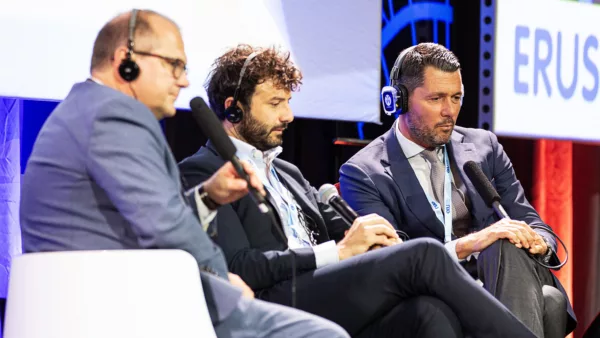
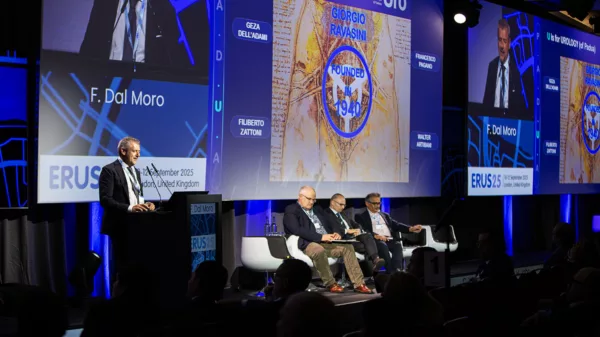
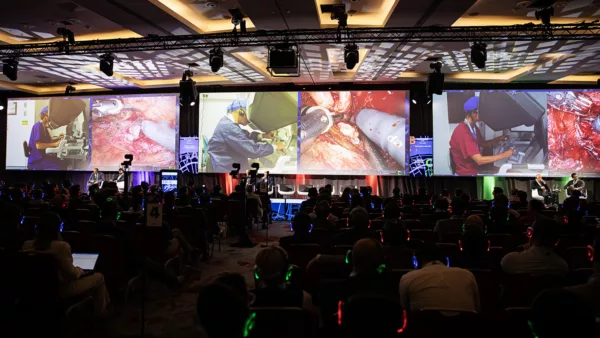
“ERUS25 in London was a busy meeting, as every year,” said Prof. Breda. “This year, with nearly 1200 participants, a record number, we’ve demonstrated that we have one of the strongest Sections within the EAU. When it comes to live surgery, it’s clear. In London we had 35 live cases, on eight platforms, and three simultaneous telesurgical cases. We were connected to the world!”
“Of course we had some nice surgical sessions but also good science, and well-attended social events. This demonstrated not only science and surgery but also a community of good people and friends. Our section and this meeting is capable of producing evidence-based medicine but also fun, and a mix if possible.”
Live cases
ERUS25 featured live surgery from four hospitals in the Greater London area (Guy’s, UCL, the Royal Free and London Bridge Hospitals) and each urology department rose to the challenge of hosting surgeons and their teams. Cases were also broadcasted from Hackensack University Medical Center (USA), Medway Maritime Hospital in Kent (GB) and Saint Vincent’s in Dublin (IE).
Prof. Breda: “If you’re ‘young enough’ to remember live surgery 25 years ago: we would report on complications at the end of every day, and every day there were one or two complications. At the end of the event, out of 15 cases, maybe 30-40% would have a complication. Nowadays this really is a rare occurrence, not just because surgeries have been standardised but because the robots and their surgeons are much improved. Live surgical cases have become a safe event. I’m proud to say that the EAU, with its live surgery policies has demonstrated to rest of the world, if performed in right manner, and following right policies, live surgery is safe.”
“Another crucial aspect is the selection of the surgeons. Not everyone is capable, psychologically, of performing in front of an audience. Sometimes we’re compared to gladiators, which I don’t necessarily agree with, but stress for the ‘performer’ is certainly multiplied in an audience setting.”
“The four local hospitals we used to host the meeting:, these are super-specialised hospitals with expert teams in robotic surgery. They provided an extremely high quality of care to their patients. Compliments to London and the NHS and all the professionals that have been working with us over the past year to make this happen.”
Rapid advancements in telesurgery
Prof. Breda made history at an EAU event at ERUS24 in Bordeaux, performing the first long-distance case on a patient in Beijing. Just one year later, telesurgery was an almost routine part of the scientific programme. From closed rooms at the ERUS25 venue, Prof. Breda and Prof. Alexandre Mottrie (Melle, BE) operated on patients in Beijing and Aalst respectively. At the same time, the audience could witness Dr. Sudhir Rawal in New Delhi operating on a patient in a local hospital while he was at the Mantra HQ a few kilometers away. What has already changed within a year or two of the debut of this concept?
Prof. Breda: “First of all, we are seeing more systems with telesurgical capability throughout the world. The interest in telesurgery and telementoring is expanding. In a sense, a network of consoles and ORs has been built over the past year.”
“Last year we only had three or four centres in the world capable of receiving a remote signal from a surgical console: now we have many more nations that are interested in starting protocols and trials so the infrastructure is becoming available. Next year, or in years to come, this will not be anything new, just another possibility.”
“Soon, there will be no limits to where we can go as a meeting. At the moment, we are limited to cities with local hospitals with robots. But in the future, you could imagine we go to a smaller city, take the consoles with us and connect to the rest of the world. It’s not fantasy, it’s not science-fiction, this is reality.”
One session at ERUS25 took long distances even further, looking ahead to surgery in space.
“This was a tremendously interesting session,” said Prof. Breda. “Aside from a glance at prototypes and concepts of the robots that will go into space and operate mostly autonomously as mankind travels to the Moon, Mars and beyond, we had a talk about the latest cloud-based networking technology. Reducing lag in telesurgery is essential and Prof. Dasgupta’s team and Alibaba Cloud worked hard to give the audience a workable demonstration.”
“Thanks to advanced compression algorithms and AI applications, they demonstrated a data connection between London and Singapore with no latency at all. At the moment, telesurgery is being performed at around 140ms, which is on the high side of what is acceptable. It’s critical to see how this will be improving. We’re entering a new era of cyber security and things related to telesurgery. It’s exciting to see what is coming.”
Science
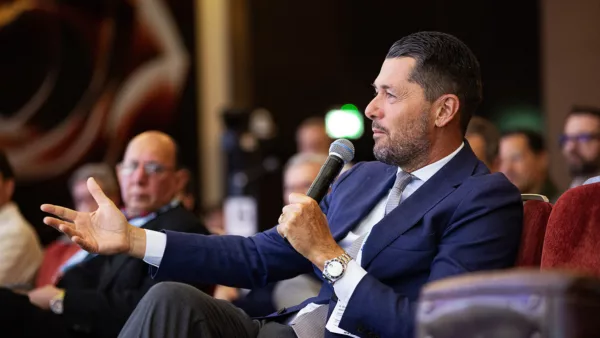
“Obviously there’s a lot of interest in the live cases, but we don’t lose sight of the science in between. I think we’ve found a good balance in our scientific programme. As I said, this is not just a live surgery event, we produce science, we have several working groups, young talented academic surgeons and physicians. The ERUS meetings are educational events looking at all 360 degrees of robotic surgery: not only scientific sessions but also ESU courses, which are very popular, at times attracting over 300 people.”
“We have abstract sessions full of innovations, video sessions, and awards for posters and videos. The protagonist is live surgery but still science is important. Whether you’re a residents, a young urologists, or even an expert, we always learn. Questions of technique, asking questions to the surgeons, and sharing experiences and opinions.”
Padua in 2026
The year has not ended but the sights are already firmly set on ERUS26.
“Padua is my city, so with some bias I can say I’m really looking forward to that edition. I was born in Verona but left at age 3. I was raised in Padua, my parents live there, I completed my undergrad and postgrad, my degree in medicine and residency there, my best friends are still there. So it’s like coming home.”
“I’m eager to show the rest of the world how beautiful it is, and what high quality medicine we produce there. In terms of participating hospitals, we have a lot of ‘firepower’ in Padua and the surrounding regions, we hope to be involving three to four centres. The head of the urology department, Fabrizio Dal Moro and the team, we will show you that Padua is ‘caput mundi’!”