
Multicentric prospective registries: A collaborative cornerstone for urethral reconstructive procedures
Urethroplasties are routinely performed in many institutions. They would be tailored, depending on the site of the urethra affected by the stricture, length, calibre of the procedure, patient preferences, and surgeon expertise. Knowing the type of urethral repairs performed could show how different techniques are employed, and how modern practices are progressively adopted. To collect this information, multicentric studies are of particular interest. This collective effort could include larger number of cases, while ensuring an adequate sample of the entire range of settings where urethroplasties are performed in one country.
Gathering real-world data on urethral surgery treatment
The Spanish Association of Urology (Asociación Española de Urologia - AEU) set up a National Urethroplasty Database as a project of the newly created Reconstructive Urology Working Group. Following a discussion on the variables and outcomes to be collected, the Ethics Committee approval was granted, and a safe web-based platform was developed for including patients.
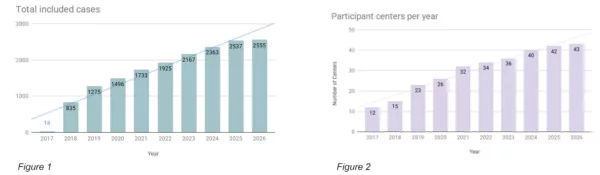
Patient inclusion began in 2017, marking the transition from conceptual framework to active data acquisition. Since then, yearly reports were presented during the annual meetings of the AEU, to ensure clear communication with the centres and the entire Spanish urological community. This registry has grown steadily, reaching a total of 2,555 cases and incorporating 43 participating hospitals, reflecting broad national engagement (Figures 1-2).
The strength of this database relies in its ability to reflect real-world clinical practice. The distribution of techniques (including excision and primary anastomosis, graft augmentation urethroplasty, and staged repairs) across centres provides insight into contemporary surgical preferences, and evolving trends. Additionally, specific technical variables, such as the type of graft or the preferred graft placement (Figure 3), could be assessed.

Assessment of pooled and individual data
Urethroplasty outcomes could be affected by any of the aforementioned factors, and the reconstructive urologist should be aware of that when discussing the treatment options and care plan with the patient. Assessing one surgeon or institution outcomes is usually not easy, and multicentric studies could help with such task.
Standardised outcome assessment is a key feature of our National Urethroplasty Database. It enables identification of the most common etiologies of urethral strictures, with iatrogenic causes consistently emerging as the leading factor. Postoperative complications are uniformly classified according to the Clavien-Dindo system (Figure 4), and longitudinal follow-up data using both objective and subjective tools would support the evaluation of surgical success and recurrence patterns.

Differences in clinical practice and follow-up protocols across centres remain potential sources of bias, and sustained participation demands institutional commitment and dedicated resources. However, including data in the registry, through rigorous data harmonization, consistent variable definitions, and quality control, would ensure heterogeneity is reduced.
The benefits are substantial, both scientifically and practically. At the first level, multicentric collaboration allows the generation of large datasets that enhance statistical power, support subgroup analyses, and improve external validity. And at the second level, single-centre data could also be extracted to assess individual performance and look for continuous quality improvement.
In conclusion, multicentric registries represent a critical tool for advancing knowledge in urethral stricture disease. By integrating data from diverse clinical environments, they enable robust, practice-reflective evidence generation, and support the optimisation of patient care.
Urethral reconstruction educational activities inside EAU
Urethral reconstruction will be featured during one of the live surgery sessions at ESGURS-ESAU26 in Ghent (BE) from 24-25 September, as well as a case presentation and debate on best practices. Abstract submission is currently open for reconstructive and andrological topics (deadline: 25 June 2026, 23:59 CEST).
* Prof. Félix Campos-Juanatey
Consultant Urologic Surgeon
Department of Urology, Marques de Valdecilla University Hospital. School of Medicine, University of Cantabria
Santander, Spain
Email: felix.campos@scsalud.es
** Prof. Victoria Capapé Poves
Consultant Urologic Surgeon
Department of Urology, Hospital Clínico Universitario Lozano Blesa
Zaragoza, Spain
Email: victoriacapp@gmail.com