
Training the Trainers: Advancing reproductive and sexual health education in Hungary
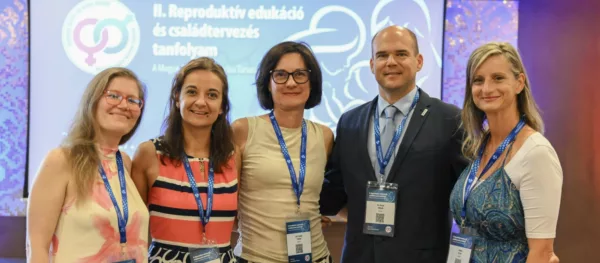
In this report, Dr. Benyó shares details of the ongoing multidisciplinary “train-the-trainer” initiative (Hungarian Reproductive Education and Family Planning Course) first held in 2025 and repeated in Budapest on 27 August 2026. It equips teachers, healthcare professionals, psychologists and other educators with evidence-based knowledge and practical communication skills to deliver comprehensive sexual and reproductive health education to young people.
A different approach to school-based education
Sexual and reproductive health education has become increasingly challenging in Hungary in recent years. Current legislation introduced specific regulatory conditions for the participation of external professionals in school-based sexual and health education. In practice, this has reduced opportunities for physicians, psychologists and other specialists to contribute directly to school programmes.
This raised a practical question: if specialists cannot easily reach students directly, how can reliable, evidence-based information still reach young people?
The Reproductive Education and Family Planning Course was created as a response. It is a joint initiative of the Hungarian Society of Sexual Medicine and the Assisted Reproduction Centre of Semmelweis University, built around a multidisciplinary train-the-trainer model. Instead of educating students directly, the programme supports those who already work with them: teachers, school psychologists, school nurses, healthcare professionals, social workers and clergy involved in education. Participation is free of charge for these groups.
A multidisciplinary approach
The first course was held in 2025 and attracted 120 participants. The second, organised in Budapest on 27 August 2026, was attended by 121 participants. Leaders and representatives of several Hungarian groups involved in sexual and reproductive education were also present, creating an opportunity for professional dialogue in addition to formal teaching.
The programme deliberately goes beyond classical biological sex education. Topics include reproductive biology, fertility, sexually transmitted infections, cancer prevention and male and female sexual health, but also the emotional, psychological, social and cultural dimensions of sexuality. Previous sessions have addressed religion and sexual education, adolescent sexual behaviour, social media, body image, sexual desire and the reproductive life course.
An important development of the second course was a psychologist-led Sex Education interactive workshop. Its aim was not simply to provide more information, but to demonstrate practical methods for age-appropriate communication and for structuring a sexual education session. This practical element is essential: knowledge alone is not enough if it cannot be translated into clear and credible communication.
Why this matters to urologists
From a urological and andrological perspective, sexual education is also prevention. Knowledge acquired during adolescence may influence later sexual behaviour, STI risk, reproductive health, help-seeking and attitudes towards male sexual and reproductive problems. Urologists therefore have a role not only in treating established diseases, but also in supporting health awareness before disease develops.
The next step is to make a larger part of the programme available through an online educational platform, while maintaining the interactive workshop component in person. The long-term goal is to keep the programme accredited and free for teachers and other professionals, and to create a common professional framework connecting organisations involved in sexual and reproductive education in Hungary.
When direct specialist access to students is limited, training those who educate them may offer a practical and scalable way to preserve high-quality sexual and reproductive health education.