
EAU AI Working Group defines its scope and priorities
Artificial intelligence (AI) is rapidly entering urological research, education, and clinical care. However, the challenges associated with its responsible use are no longer purely technical; they also encompass important ethical considerations, as reflected in recent public debate. Leading AI developers, including OpenAI, have themselves called for stronger safeguards and a more cautious approach to deployment.
Accordingly, data quality and access, independent validation, regulation, transparency, workforce competence, and sustainable implementation have become equally important. These challenges cut across urological disease areas and require coordination beyond any single subspecialty or section. The European Association of Urology has therefore established an Artificial Intelligence Working Group under the umbrella of the Section Office to connect expertise and support responsible progress across the association.
A supporting role across the EAU
The Working Group is intended as a connector and enabler, not as a central owner of AI-related work. Disease-specific clinical and scientific questions remain with the established EAU sections, offices and project teams that hold the relevant urological expertise in their field. A prostate cancer imaging project, for example, should continue to be led by the groups responsible for prostate cancer and imaging. The Working Group can help identify methodological partners, encourage external validation, and connect teams facing similar technical or governance questions. It will not replace existing initiatives, require umbrella authorship, or assume responsibility for the scientific conduct of section-led projects. This distributed model preserves ownership where it belongs while making cross-cutting expertise easier to access.
Education and policy as the first priorities
With this in mind, two priorities come first which are important across the community without interfering with disease-specific projects: education and policy. AI literacy is increasingly relevant for every urologist, not only for researchers developing algorithms. Clinicians need to understand core terminology, appraise AI studies, interpret common performance measures, recognise bias and limited generalisability, verify generative outputs, and distinguish promising prototypes from tools that are ready for practice. Therefore, first learning opportunities were already established across career stages. Basic and advanced AI courses were offered at the EAU Congress, a dedicated podcast series has been developed, and two linked educational papers covering introductory and advanced AI concepts are currently being prepared for publication. These activities may be complemented by further webinars, concise reference materials, and international cooperation with other societies.
Policy is the second central pillar. Urologists need practical guidance on how the EU Artificial Intelligence Act, the Medical Device Regulation and related data rules affect research, procurement and clinical implementation. Relevant questions include accountability, intellectual property, data access, transparency, human oversight and post-deployment monitoring. Initial work was undertaken closely with the EAU Policy Office and appropriate legal and regulatory experts.
Opening survey
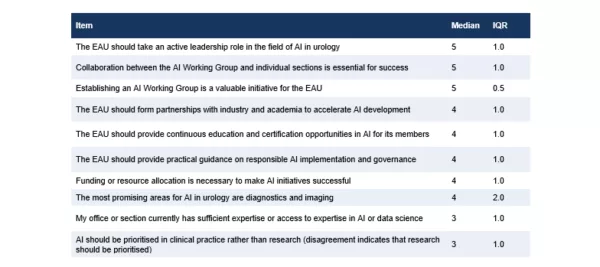
An exploratory stakeholder survey (see table below) distributed through EAU Sections and Offices between December 2025, and May 2026 helped define these initial priorities. Responses were available from 103 participants. Support for the initiative and its collaborative model was strong: 89% considered establishing an AI Working Group valuable, 90% regarded collaboration with the sections as essential, and 90% supported an active EAU leadership role in AI. Education and certification were supported by 82% of respondents, while 79% called for practical guidance on responsible implementation and governance.
For more information, view EAU Artificial Intelligence Working Group.